

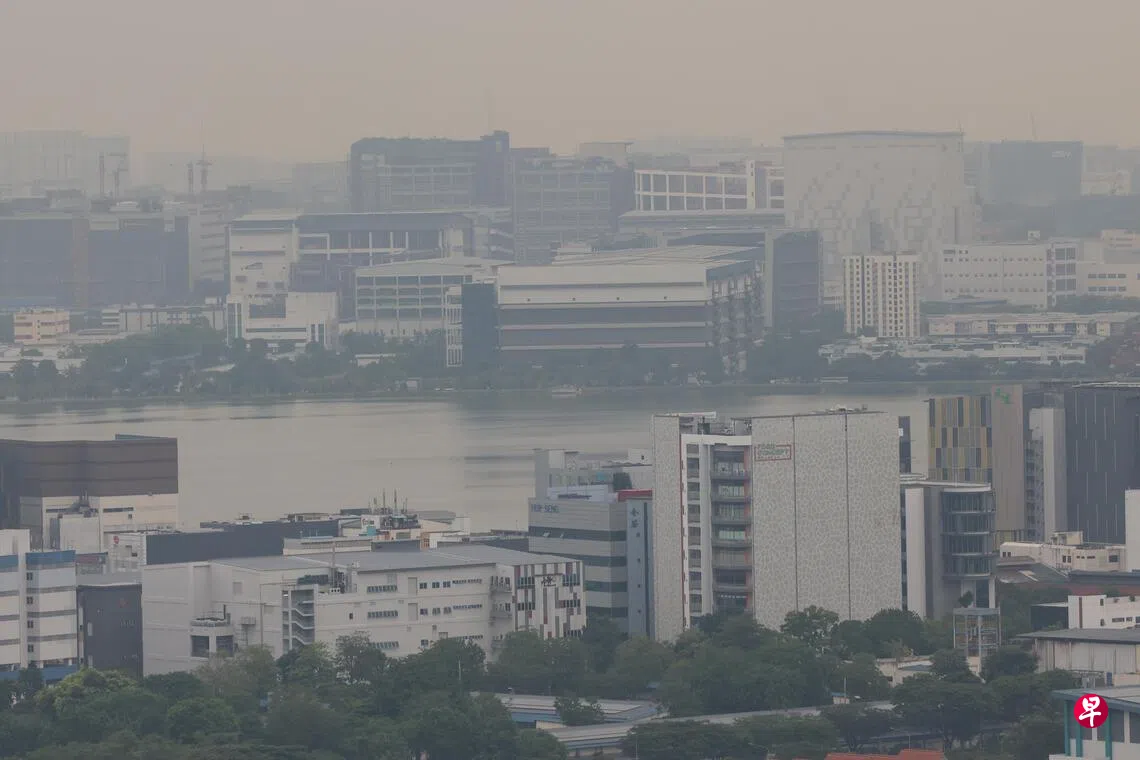
Shares in some Singapore companies fell after the government summoned their senior executives to a meeting over their possible involvement in the haze. The companies had earlier received statutory notices.
Some investment institutions have bought palm oil and plantation stocks following the recent market pullback, seeing potential upside in their valuations.
However, analysts said these companies still face risks from El Niño and Brent crude oil prices, which could keep raw material prices elevated. They could also face higher financing costs as the government demonstrates sustained and firm enforcement.
Deputy Prime Minister and Minister for Energy, Trade and Industry (Trade) Gan Kim Yong, Senior Minister, Coordinating Minister for National Security and Minister for Home Affairs K. Shanmugam and Minister for Sustainability and the Environment Grace Fu met the chief executives of companies potentially involved in the haze on Wednesday (28 October).
Following the news, shares in major Singapore agribusiness group Wilmar International closed sharply lower on Thursday, falling 4.89%. First Resources fell 2.99%, Bumitama Agri lost 2.44% and Indofood Agri Resources declined 2.94%.
Plantation stocks have fallen for several days, with some investment institutions taking the opportunity to buy in. According to a statement released by Golden Agri-Resources after the market closed on Wednesday, US investment management firm Kopernik Global Investors bought an additional 5.5 million shares last Friday (23 October) at S$0.275 each, for a total of about S$1.51 million.
Ada Lim, an equity analyst at OCBC, told Lianhe Zaobao (LHZB) that she continued to believe investors should remain cautious. “At present, it is not clear how long the regulatory overhang will persist. Sentiment around plantation stocks remains weak and headline-driven, and independent assessments will likely take time to yield results.”
The Singapore Exchange had earlier sought further clarification from these companies to better understand their circumstances and their exposure to forest fires and haze.
So far, only Wilmar International has provided a clear response. The company said fires had affected about 28 hectares of land on its plantations in Indonesia's West Kalimantan province.
Local police are conducting preliminary investigations into the incidents, and the fires are believed to have originated outside the plantation concession areas.
Wilmar International's results released earlier also showed that its net profit for the third quarter of this year fell 22.9% year on year.
DBS group research analyst William Simadiputra said the results fell short of consensus expectations, showing that sales volume growth in the company's food products segment had failed to offset higher raw material costs.
Beyond haze, plantation stocks face climate risks and oil-related cost pressures
Simadiputra said: “El Niño risks and elevated Brent crude oil prices could keep raw material prices, particularly those across edible oil complexes, high and continue to pressure margins.”
Another plantation company, First Resources, had earlier faced claims that a skull suspected to be that of an orangutan had been found in its palm oil concession area in Indonesia. In addition, 2,382 hectares of forest within the company's concession areas had been burnt.
However, an analysis by RHB said that although this was negative environmental, social and governance (ESG) news that would put some pressure on the company in the short term, the direct impact on its operations was limited.
Even if the subsidiary operating the affected forest land halted production for the rest of this year, the estimated impact on output would be only about 1%.
On the government's plans to amend haze-related laws, Lim said that if these companies were ultimately penalised far more heavily than expected, a higher regulatory risk premium could be priced into plantation stock valuations.
“Additionally, the Monetary Authority of Singapore has called on banks to adopt stronger measures against corporate clients in breach of environmental laws, such as limiting or exiting such relationships. This may increase funding costs for these companies and further weigh on valuations.”
