

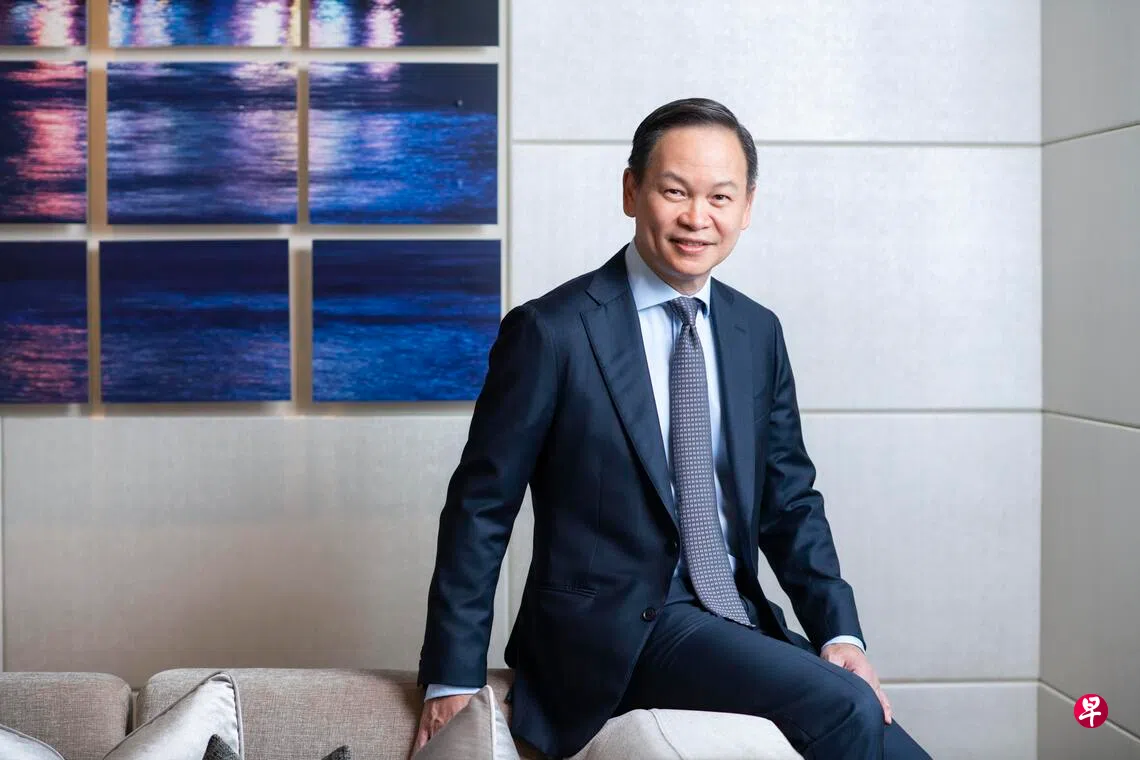
Indonesia’s government has sharply cut nickel mining quotas this year, while international ratings agency MSCI has warned of a downgrade for the country’s stock market, drawing attention to its investment climate and foreign capital flows. However, Sam Cheong, head of group foreign direct investment (FDI) advisory at United Overseas Bank (UOB), believes Indonesia remains an important investment market in ASEAN.
In a recent joint media interview, he said: “I think what people are looking at in the longer term is that a huge consumer market is still there. That will never change. And whatever is developing, I think Indonesia is still a very key part of ASEAN.”
Cheong also noted that foreign direct investment inflows into ASEAN have doubled since the ASEAN Economic Community was established in 2015. The region’s demographic dividend, large market, complementary industries and resources across member states, and changes in tariffs have accelerated foreign investment inflows.
ASEAN is one of the world’s leading destinations for foreign direct investment (FDI), attracting US$244 billion (about S$312 billion) last year. Continued unity among member states would help strengthen the region’s appeal.
Cheong said foreign investors favour ASEAN because they can build long-term, sustainable businesses here. As long as ASEAN remains united and maintains ASEAN centrality in its engagement with partners around the world, it will undoubtedly be a highly attractive region.
Meanwhile, intra-ASEAN investments are also growing, with Singapore accounting for about 70% to 75% of these flows.
Cheong noted that Singapore’s extensive network of free trade agreements, good governance and robust legal system attract companies to establish their regional headquarters here before expanding into other regional markets.
“A lot of FDI I see recently is not just going to one country. After Thailand, they may go to Indonesia or to Vietnam. And therefore, ultimately they need a holding company to consolidate their investment in the most optimal way in terms of tax, in terms of managing their risk and share resources.”
Indonesian stocks and rupiah face repeated pressure this year
Indonesia’s government has tightened policy this year, sharply reducing the annual nickel mining quota from last year’s 379 million tonnes to between 250 million and 260 million tonnes.
Lianhe Zaobao (LHZB) previously reported that the China Chamber of Commerce in Indonesia had sent an open letter to Indonesian President Prabowo Subianto outlining various problems Chinese companies face in the country, including the sharp reduction in nickel mining quotas. Chinese companies are the largest investors in Indonesia’s nickel industry.
In addition, international ratings agency MSCI’s warning of a downgrade for Indonesia’s stock market has intensified concerns over foreign capital outflows. Indonesian stocks and the rupiah have also come under repeated pressure this year.
When asked whether Chinese foreign direct investment was being withdrawn from Indonesia, Cheong said foreign capital flows are highly flexible. Companies continually adjust to their own needs and market opportunities, sometimes accelerating investment and sometimes slowing it, depending entirely on conditions at the time.
He said Chinese foreign direct investment into Indonesia slowed last year, but had performed much better in other years.
Separately, the repeatedly delayed master plan and blueprint for the Johor-Singapore Special Economic Zone are expected to be released by the end of this year.
In response to queries from LHZB about whether the delay in releasing the zone’s long-term development plans would affect investor confidence, Cheong said: “Companies will continue to invest, with or without a development blueprint, as long as they see an opportunity to make a profit.”
He noted that Johor is not a new investment destination, and that his team had been helping companies invest there well before the special economic zone was established.
While policy is important, he believes it is not the main factor determining whether many companies invest.
“Companies must fundamentally examine why they are here, and cannot come solely because of policies. Policies benefit them, but they need to take a longer-term view.”
Working with governments and chambers of commerce to create a multiplier effect
UOB has 11 FDI centres across Asia, including in Malaysia, Thailand, Indonesia, Vietnam, India, Japan and China.
To date, UOB’s FDI advisory unit has helped more than 6,000 companies expand in the region. Since 2020, it has facilitated more than S$65 billion in investments and created over 350,000 jobs.
Cheong said building long-term partnerships with government investment promotion agencies and working with local chambers of commerce helps connect foreign investment projects with local small and medium-sized enterprises (SMEs).
As these large multinational companies bring in more orders, SMEs hire more workers, creating a multiplier effect, he said.
