

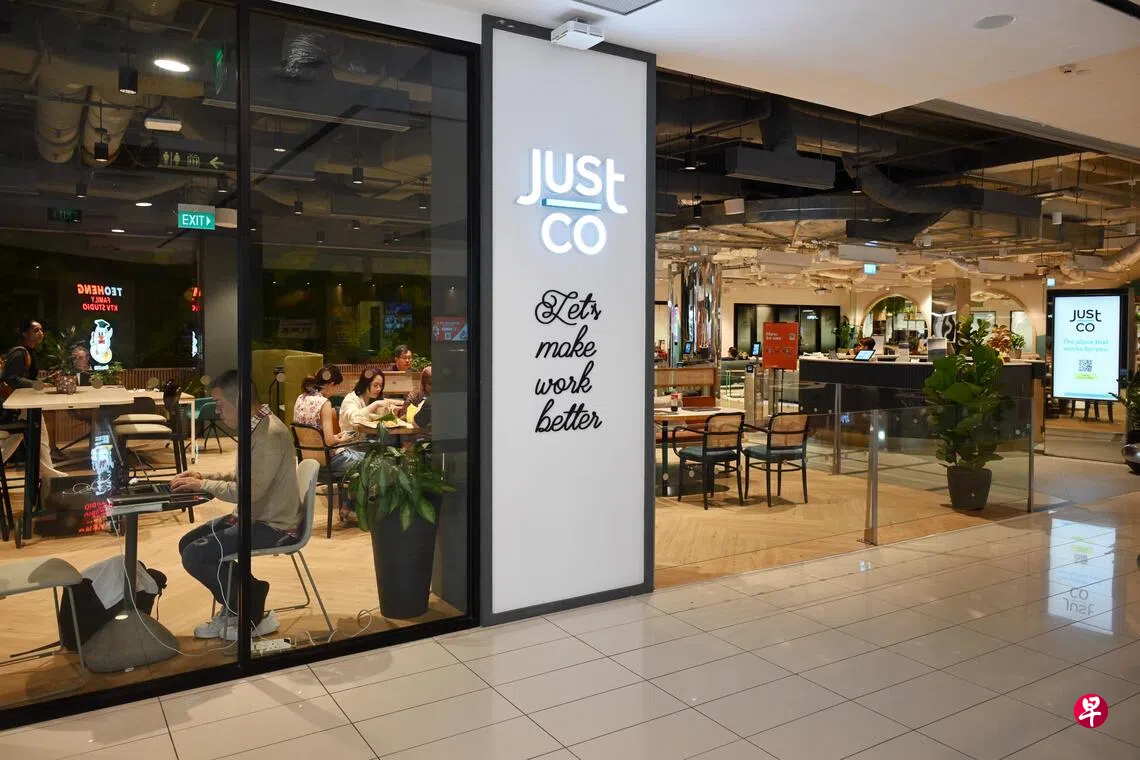
Singapore flexible workspace operator JustCo’s shares have fallen further recently, leaving them 60% below their initial public offering price. An analyst said expectations of interest rate hikes could be a factor behind the weakness.
Another view among analysts is that the company should disclose more data to help investors better assess the stock’s prospects.
JustCo fell 2.63% to S$0.37 on Friday (30 October), its lowest level since listing in May.
Miaomiao Liu, equity research analyst of Maybank Securities Singapore, told Lianhe Zaobao (LHZB) that the recent weakness in JustCo’s share price could partly reflect changing market expectations for interest rates. However, the decline could not be attributed entirely to interest rates.
She noted that JustCo has ample cash reserves and limited bank borrowings, so higher interest rates would have little direct impact on its near-term earnings.
However, rising interest rates push up discount rates, reducing the valuation multiples investors are willing to pay for the company’s future growth. Investors may also be more cautious about the flexible workspace business model, given JustCo’s long-term lease commitments and its still-developing profitability.
Liu said no new factors had emerged that would change her fundamental assessment of JustCo’s earnings outlook. The key areas to watch next are the company’s occupancy rates, the progress of its new centres and its cash EBITDA conversion.
In her view, higher interest rates mainly affect JustCo’s valuation and market sentiment, rather than putting significant pressure on earnings.
JustCo, which counts Singapore sovereign wealth fund GIC among its investors, saw its shares fall below their offer price after listing. Founder and chief executive Kong Wan Sing has since bought shares on the market several times. His latest purchase was on 21 October, when he bought 80,000 shares at an average price of S$0.41 each, raising his stake to 18.7%.
GIC holds a 22.7% stake in JustCo but does not comment on individual investments.
Three firms rate JustCo a “buy”
All three firms that cover and rate JustCo recommend buying the stock, with an average target price of S$1.08.
An unrated research report by Singapore corporate research firm Corporate Monitor said JustCo’s disclosures on some key operating metrics remained insufficient. These include break-even occupancy rates, the payback period for investments in centres, and the profitability of centres at different stages of maturity.
The report noted that JustCo’s earnings improvement over the past two years had largely been achieved without a significant increase in the number of centres. Higher occupancy rates also helped drive operating leverage.
JustCo plans to increase its network to about 100 centres by the end of 2028. Investors’ focus has shifted from whether the company can grow revenue to whether its new centres can turn a profit.
JustCo’s management told Corporate Monitor that the company’s break-even occupancy rate was about 60%. However, based on cash rental expenses and other operating expenses in 2025, Corporate Monitor estimated the overall break-even occupancy rate at about 70%. JustCo remained loss-making in both 2023 and 2024, when occupancy was 78%, and only turned profitable when occupancy rose to 84% in 2025.
Corporate Monitor said this showed that operating conditions varied across markets and centres, and that a single overall occupancy rate was insufficient to assess the company’s profitability.
JustCo’s revenue rose 24.1% year on year to US$80.8 million (about S$102.6 million) in the first half of this year, while cash EBITDA more than doubled to US$10.6 million.
Responding to queries from LHZB, Impact Capital Asset Management’s chief investment officer Atul Tetambe and deputy portfolio manager Tan Kian Wei noted that JustCo recorded a loss of US$840,000 after deducting its remaining expenses. Operating cash flow of US$45.01 million fell short of the combined US$49.1 million in lease principal payments, interest and capital expenditure, leaving a US$4.09 million shortfall, compared with a US$6.18 million surplus a year earlier.
They added that the earnings improvement came mainly from “other” operations outside the company’s four main markets. The company did not provide further details on the markets, number of centres or performance of these operations.
They also said the share price decline could not be attributed to any single factor.
