

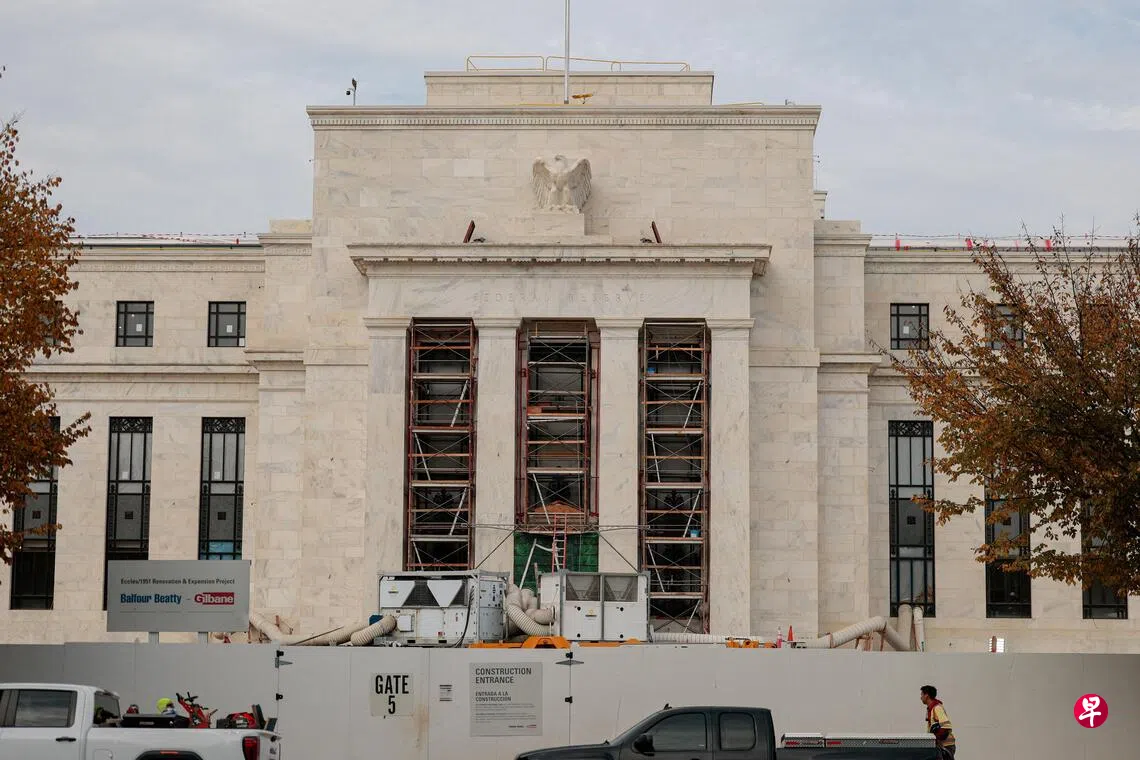
The US Federal Reserve held interest rates steady as widely expected, though resilient economic growth and elevated inflation have led markets to price in two more rate hikes—one in December and another in March next year.
Analysts say the Fed’s pause does not mean Asian central banks will follow suit. Asian markets will increasingly be driven by their own economic and policy cycles.
Following the announcement, most Asian stock markets fell on Thursday (29 October), although this was driven more by weaker-than-expected tech earnings. As of 6pm, the US dollar was steady, while spot gold had fallen nearly 1% to below US$4,030 an ounce.
Michael Langham, emerging markets economic analyst at Aberdeen Investments, said the Fed’s decision was in line with expectations. The meeting delivered few surprises, reflecting policymakers’ desire for more time to assess developments in the economy and markets.
Fed Chair Kevin Warsh remained optimistic about the economic outlook, but reiterated that inflation was still too high.
Langham therefore expects the Fed to raise rates by 25 basis points each in December and March next year, taking the terminal rate to 4.25–4.50%. He described these as “precautionary rate rises”, rather than aggressive measures to sharply curb demand and rein in high inflation.
Max Stainton, senior global macro strategist at Fidelity International, also expects the Fed to raise rates once in December and again in March next year.
In its latest statement, the Fed upgraded its assessment of economic activity, while stressing the need to gather more data before deciding its next move.
Stainton believes capital expenditure linked to artificial intelligence (AI) will continue to support US economic growth. With the labour market also regaining strength, US inflation could rise to about 3.4% by the end of this year before gradually easing to around 2.5% next year. If global supply constraints persist next year, the Fed may need to raise rates once more, in addition to those two increases.
Warsh also announced that the Fed would make fewer interest rate decisions over the next two years. It will still hold eight meetings a year in 2027 and 2028, but will make only seven rate decisions next year and six the year after. This is meant to give the Fed time and space for strategic discussions, to rethink major issues and take a longer-term view.
Stainton said having fewer meetings dedicated to interest rate decisions could further increase the importance of each policy meeting, while sharpening market attention on inflation, employment and economic data released between meetings.
Cheong Wei Ming, a portfolio manager at Eastspring Investments, told Lianhe Zaobao (LHZB) that the outcome of the Fed’s latest meeting was unlikely to have much impact on Singapore and regional markets, as it was in line with expectations. He expects Singapore dollar interest rates to have bottomed out and to be more influenced by global interest rates from here.
The Monetary Authority of Singapore surprised markets by keeping monetary policy unchanged this month. The three-month Singapore Overnight Rate Average (SORA) has edged up three basis points to 1.2683% so far this month.
On Asian markets, Navin Saigal, head of global fixed income for Asia-Pacific at BlackRock, said the Fed’s pause does not mean Asian central banks would also stand pat. Monetary policy paths are increasingly diverging as economies face different growth, inflation, exchange rate and external pressures.
He said China’s relatively weak inflation and demand mean its policy direction differs from that of the US. Australia and some Northeast Asian economies still face considerable inflationary pressures, while Japan continues to normalise monetary policy.
In Southeast Asia, AI demand and energy prices are also affecting economies differently. Singapore’s third-quarter gross domestic product (GDP), for example, grew 5.4% year on year, driven mainly by AI-related demand.
Langham cautioned that rising oil prices would continue to put pressure on the currencies of Asian energy importers, while US dollar funding conditions could tighten further.
As the energy shock adds to governments’ fiscal burdens, many Asian countries may gradually scale back broad-based energy subsidies and support measures in favour of more targeted assistance. Further monetary tightening may also become necessary for the Philippines, India and Indonesia, whose currencies are under pressure.
