

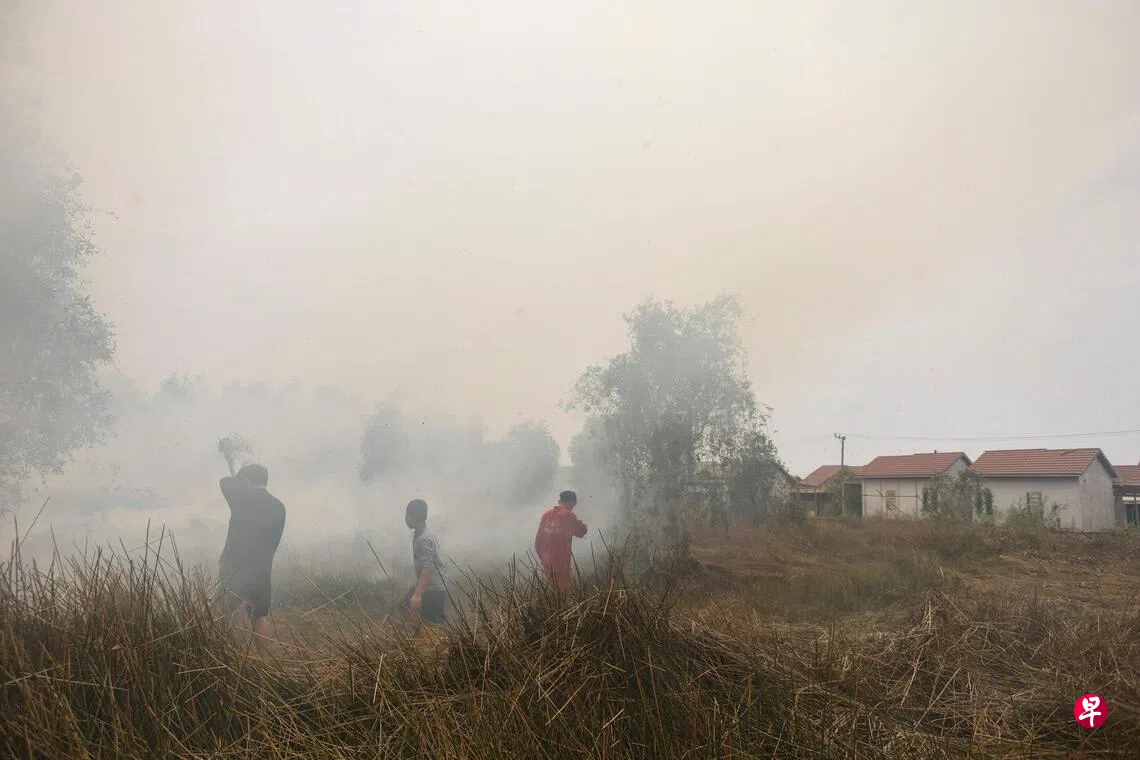
Recurring bouts of transboundary haze, the same old buck-passing by politicians — it all seems to be playing out scene by scene, faithfully following a well-worn script.
First, forests and peatlands in Indonesia catch fire, whether naturally or through human activity. This year, a super El Niño has made the fires even fiercer. Thick smoke drifts towards Singapore and Malaysia, blanketing both countries in haze. As Pollutant Standards Index (PSI) readings soar and people suffer, the governments raise their concerns with Indonesia. They closely monitor hotspots, publicly name companies suspected of burning land for cultivation, seek Indonesia’s cooperation in investigations and offer help to fight the fires.
Then the familiar political drama unfolds.
Some Indonesian politicians begin voicing their displeasure, saying we have overreacted to the haze. They even suggest that we are ungrateful: we complain about the haze Indonesia exports but never thank its forests for the oxygen they normally “provide”.
Does all this not sound familiar?
I recently published a commentary in Yihe Shiji entitled “Environmental haze can be tackled, but political haze is hard to guard against”. Written in early July, it cited a Singapore Institute of International Affairs report forecasting possible severe transboundary haze in August and September, and recounted the severity of previous haze episodes. The article argued that transboundary haze is not just an environmental disaster but a complex problem involving economic interests, administrative capacity and political manoeuvring. No matter how prepared Singapore is, it cannot escape the haze. Yet some Indonesian politicians respond to their neighbours’ legitimate concerns with nationalist rhetoric, even turning environmental responsibility into a contest over national dignity, creating another kind of “political haze”.
The article concluded: “Environmental haze obscures the sky; political haze obscures right from wrong. If an information haze adds to the confusion, concealing facts and misleading the public, with both air and information PSI readings soaring, we can only hope for the best!”
As the article was published in the latest issue of Yihe Shiji between August and September, a ferocious bout of haze rolled in and shrouded the sky. What the article described unfortunately came true on every count — right down to the "unpreventable" political haze, which once again swept across the border right on cue!
What I had not anticipated was that this year’s political haze would be even more intense and choking.
Let us first look at how some Indonesian politicians’ past remarks have helped spread this political haze.
In 2013, Indonesia’s Coordinating Minister for People’s Welfare Agung Laksono said: “Singapore should not keep making a fuss like a child. Indonesia did not want the haze; it was caused by nature.” Energy and Mineral Resources Minister Jero Wacik also accused Singapore and Malaysia of being ungrateful, saying they should not “complain to the whole world”.
Although then President Susilo Bambang Yudhoyono promptly issued a formal apology to Singapore and Malaysia, ordering his officials to stop playing the “blame game” and act swiftly to put out the forest fires and eliminate the haze, his statement drew widespread criticism from Indonesian politicians and media. They accused him of “going too far”, “showing weakness”, “bowing to foreign pressure” and “damaging national dignity”.
In 2015, Vice-President Jusuf Kalla made a remark that remains seared into people’s memories: “You enjoy fresh air from Indonesia for 11 months, but complain about one month of haze.”
Why do some Indonesian politicians treat Singapore with such condescension? An article published by the S. Rajaratnam School of International Studies (RSIS) in October 2015, “The Trouble with Indonesia-Singapore Relations”, offered a perceptive analysis. Written by Barry Desker, Singapore’s former ambassador to Indonesia, it discussed disputes over haze, airspace, assets and corruption. It noted that although the two countries have close political, trade, investment and people-to-people ties, undercurrents in bilateral relations cannot be ignored. Relations were generally good under former President Suharto. But as Indonesia democratised and populist politics gained ground, Singapore became an increasingly easy target for Indonesia’s domestic political infighting and nationalist sentiments.
Desker argued that some Indonesians harbour a complex mix of envy, fear and suspicion towards Singapore. They believe resource-poor Singapore has prospered on Indonesia’s back without giving enough in return. This “big brother mentality” leads some Indonesian politicians to see the two countries not as equal partners, but as a relationship in which Singapore owes Indonesia a debt of gratitude.
Judging by Indonesian politicians’ recent remarks about Singapore, that mentality has not changed.
As the haze went from bad to worse, Minister for Sustainability and the Environment Grace Fu finally spoke out in mid-October. She said Singapore had remained in contact with Indonesia and stood ready to help contain the haze. Asked whether Singapore would invoke the Transboundary Haze Pollution Act to act against companies responsible, she said the government was gathering relevant data, would assess it carefully and was keeping all options open.
Unexpectedly, these entirely reasonable remarks provoked a backlash from Indonesia. The first to attack was former Indonesian trade minister Muhammad Lutfi, who posted a video on social media addressing Fu directly. He criticised the Singapore government for issuing notices to Indonesian companies linked to forest fires without taking sufficient concrete legal action. He even accused it of making such statements merely to win favour with Singaporean voters. He claimed that if Singapore truly wanted to hold those responsible for the haze to account, it should not target only companies operating in Indonesia. It should also investigate the relevant groups with headquarters, holding companies or business operations in Singapore, insinuating that Singapore dared not take on major companies listed in its own market.
Lutfi is a seasoned politician well versed in playing to public sentiment. In the video, he deliberately adopted a mocking, sarcastic tone, seeking to stir emotions and strike a chord with his audience.
But if he was not trying to divert attention, he was choosing to forget that even if these companies’ holding entities are based in Singapore, their operating subsidiaries are in Indonesia, where the fires occur. Indonesia has neither agreed to let Singapore help put out the forest fires nor been willing to assist investigations into companies’ land-burning activities and the necessary collection of evidence. He may also have forgotten an important episode: in 2015, Singapore first invoked the Transboundary Haze Pollution Act to issue preventive measures notices to Indonesian companies suspected of causing the haze. When it took further enforcement action the following year, Indonesia protested on sovereignty grounds.
Then Vice-President Jusuf Kalla stressed that the alleged offences had occurred within Indonesia and could not simply be dealt with under Singapore law. Environment and Forestry Minister Siti Nurbaya Bakar accused Singapore of disrespecting Indonesia. The Singapore government promptly clarified that the Act was consistent with international law and aimed to hold companies accountable for causing transboundary pollution, not infringe Indonesia’s sovereignty. The matter eventually came to nothing.
On 19 October, Senior Minister, Coordinating Minister for National Security and Minister for Home Affairs K. Shanmugam responded. He declared that Singapore would broaden its investigations into companies involved in transboundary haze, as well as the groups and controlling parties behind them. It would consider applying pressure through legal, regulatory and economic measures, and was prepared, if necessary, to amend legislation urgently or enact new laws to secure companies’ cooperation. He stressed that companies should not assume they could evade their responsibilities in Singapore simply because the evidence and wrongdoing were in Indonesia, warning them not to underestimate the Singapore government’s determination to act.
With his arguments wholly untenable, Lutfi abruptly shifted the battleground from haze to finance. In an Instagram post on 20 October, he alleged that Temasek and GIC were using their influence over index provider MSCI to push for Indonesia’s reclassification from an “emerging market” to a “standalone market”, so they could buy Indonesian assets cheaply. MSCI had announced on 15 October that it was considering such a move, triggering panic selling in the Indonesian stock market.
Temasek and GIC immediately denied this serious and baseless allegation. Former Indonesian deputy foreign minister Dino Patti Djalal also took issue with it, publicly rebutting claims of a Singaporean plot to undermine Indonesia’s stock market. He stressed that Singapore had a vested interest in Indonesia’s stability and prosperity.
“We’ve got friendly neighbours? Grow up!”
Lutfi’s remarks reflect a longstanding political phenomenon: Indonesian politicians appeal to nationalist sentiment when faced with difficulties at home. But he is, after all, a relatively minor figure. The Indonesian government’s subsequent escalation deserves greater attention.
On 21 October, Indonesian President Prabowo Subianto spoke publicly on the matter for the first time, accusing some countries of using the forest fires to “insult Indonesia”. He told a cabinet meeting: “Indonesia is a courteous and patient country. Our country is often insulted, but believe me, we are certainly not willing to be insulted indefinitely.”
He did not name the countries “that like to insult Indonesia”, but did he really need to spell it out?
On 22 October, Indonesia’s Coordinating Minister for Downstream Industries and Energy Transition Bahlil Lahadalia warned that it might stop exporting energy to countries that “do not respect” Indonesia. He also said it was considering not renewing gas export contracts with neighbouring countries, to prioritise domestic energy needs. Differences between countries, he said, should be resolved through dialogue and mutual respect. “Don’t come begging when you need something, but when there is another issue that can actually be discussed, behave like a relative who has no manners. This is what we do not want.”
On 23 October, Indonesia formally announced that it would reduce gas supplies to Singapore from the following day by 31 billion British thermal units a day, equivalent to about 877,800 cubic metres of natural gas. Supplies to other countries would continue as usual.
It all happened so quickly. While some Singaporeans were still trying to work out how their government’s remarks had “insulted” or “disrespected” Indonesia, it had already taken decisive action.
So Singapore was that “relative who has no manners”, deserving a lesson from “big brother”!
What more vivid lesson in reality could there be? Thank you, big brother, for giving Singaporeans such an illuminating lesson in international politics — one that needed no teacher to explain it!
It inevitably brought to mind founding Prime Minister Lee Kuan Yew’s famous, bracing words: “We’ve got friendly neighbours? Grow up!” The remark appears in Lee Kuan Yew: Hard Truths to Keep Singapore Going, published in 2011. He made the remark during a group interview with journalists from The Straits Times for the book. Discussing Singapore’s vulnerability as a small country, he stressed that we could not base our national security on the assumption that our neighbours would always be friendly.
Events today show that this is indeed a “hard truth”. Lee observed Indonesia, an important neighbour, closely, and maintained close ties with some of its leading figures, as is evident from his memoir, The Singapore Story. For example, he met Prabowo several times between 1996 and 1998 and recorded his observations. Having helped compile and translate the Chinese edition of Lee’s memoirs, I remembered these passages. Rereading them recently offered fresh insights and left me rather less surprised by some of the recent news.
Whatever happens, we cannot choose our neighbours or dictate geopolitics. We must face reality. We must do our utmost to maintain good relations with neighbouring countries, deepen our understanding of them and seek the broadest possible common interests. But we must also keep strengthening ourselves, plan ahead, maintain adequate stockpiles, diversify our energy and food sources, and build long-term resilience. That way, when a crisis strikes, we will be well prepared and able to respond calmly.
The gas supplies cut by Indonesia this time amount to less than 2% of Singapore’s daily gas needs. Because Singapore had planned for the long term and diversified its supply sources, the Energy Market Authority was able to respond calmly: Singapore has measures in place to manage the reduction in supply.
As I was writing this, some positive news arrived. Foreign Minister Vivian Balakrishnan made a two-day visit to Indonesia early this week, meeting its new foreign minister, Arrmanatha Christiawan Nasir, on 27 October. Together, they later announced that the two countries would establish a joint working group to coordinate closely and share information on holding companies involved in forest fires accountable.
On 28 October, Balakrishnan also met Prabowo at his private residence. At a subsequent press conference, he said: “Communication has occurred at the highest level between my Prime Minister and with President Prabowo. It sets the political commitment on both sides to do what is necessary, and now we will have to implement those plans, execute that commitment.”
This is undoubtedly a positive development. Hopefully, such direct and candid communication between the two countries’ leaders will help address the root causes of transboundary haze, allowing both the environmental and political haze to clear for good.
But it is unrealistic to expect a swift resolution to a transboundary haze problem that has persisted for 50 years. We must hope for the best, prepare for the worst, maintain strategic composure and make every necessary preparation.
The writer is a former editor-in-chief of Lianhe Zaobao (LHZB).
