

Mosaic pieces are the smallest units in mosaic art. Though a tiny piece of coloured stone, glass, ceramic, shell or metal may seem unremarkable on its own, once they are cut, arranged and assembled, these fragments gradually form a complete picture. They once made up magnificent murals in ancient Roman and Byzantine buildings and European churches. For Singaporeans, mosaics are the texture of tables and seats beneath HDB blocks, the familiar little tiles on dragon playgrounds and memories shared across generations.
In an age that values speed, crafts that must be assembled piece by piece seem to run against the times. Yet in Singapore, a love of the craft still draws people into lasting relationships with mosaics through the daily work of shaping and refining them. A glass artist brings more than four decades of experience to her work, a 73-year-old man has turned a livelihood from his youth into a source of fulfilment in old age, and a millennial designer brings childhood memories of HDB void decks into modern homes. Three styles and three lives shine through the pictures they assemble, one fragment at a time.
The allure of light through coloured glass
Felicia Yong Shiow Foong, the 61-year-old founder of glass art studio Art by Felicia, has worked with stained glass for more than 40 years. After graduating from art college at 19, Yong was introduced by her art teacher to an American woman artist, under whom she studied stained glass. That was in the early 1980s, when few people in Singapore knew much about the craft and stained glass was rarely seen in everyday life outside churches. What captivates her about the craft is the relationship between glass and light. The moment in which sunlight passes through coloured glass, casting rainbow-like patterns on floors and walls, has never lost its appeal for her.
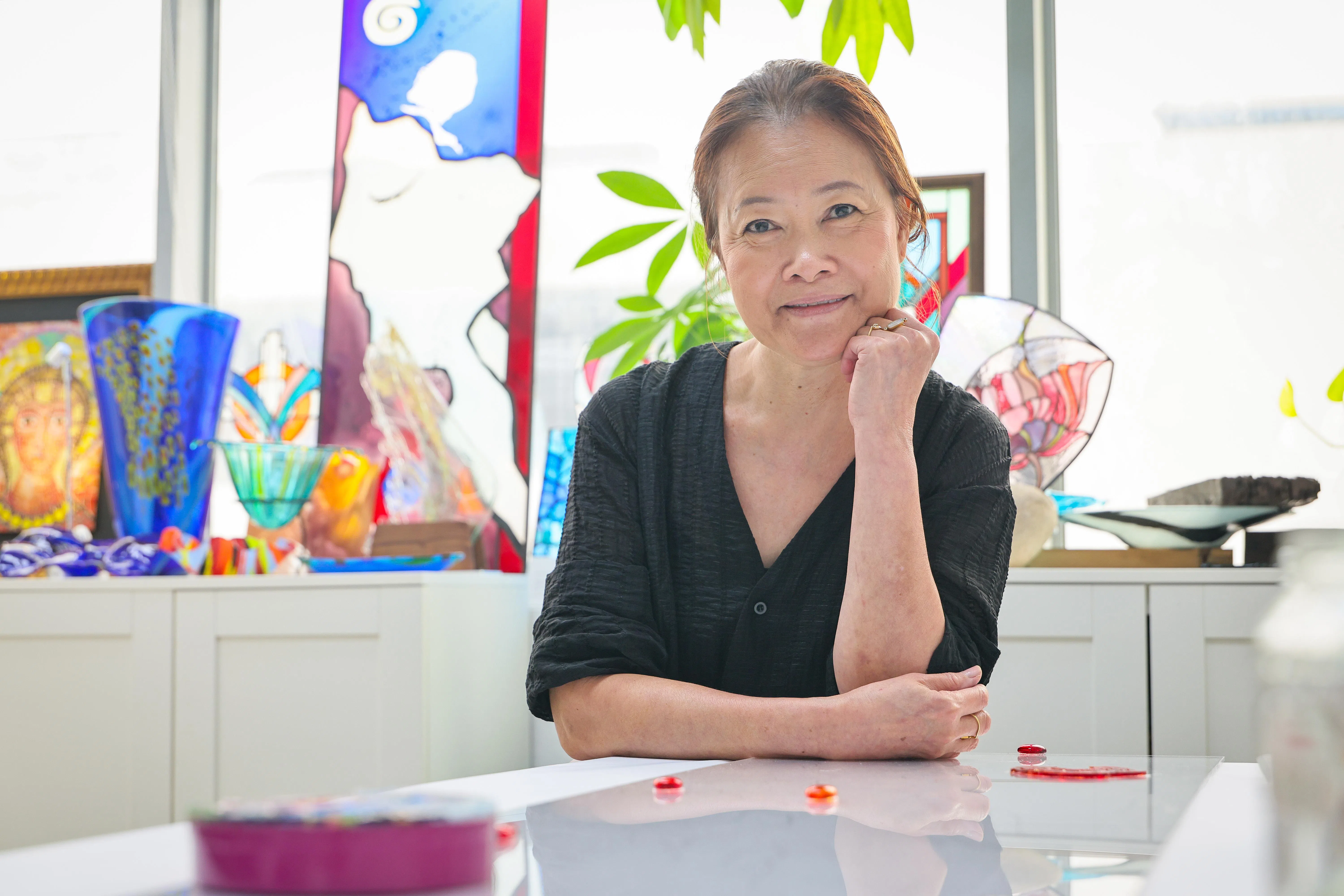
There are many stained-glass techniques. The classic Tiffany style involves wrapping the edges of glass pieces in copper foil before soldering them together, and can be used to make lampshades, curved surfaces and three-dimensional works. Filati micromosaic uses tiny strands of glass to create intricate compositions. Another is andamento, a technique Yong particularly enjoys and excels at. For this technique, small mosaic pieces, or tesserae, are arranged to establish a direction of flow or line. Its emphasis on movement and rhythm gives a static mosaic the dynamic quality of flowing water or wind.
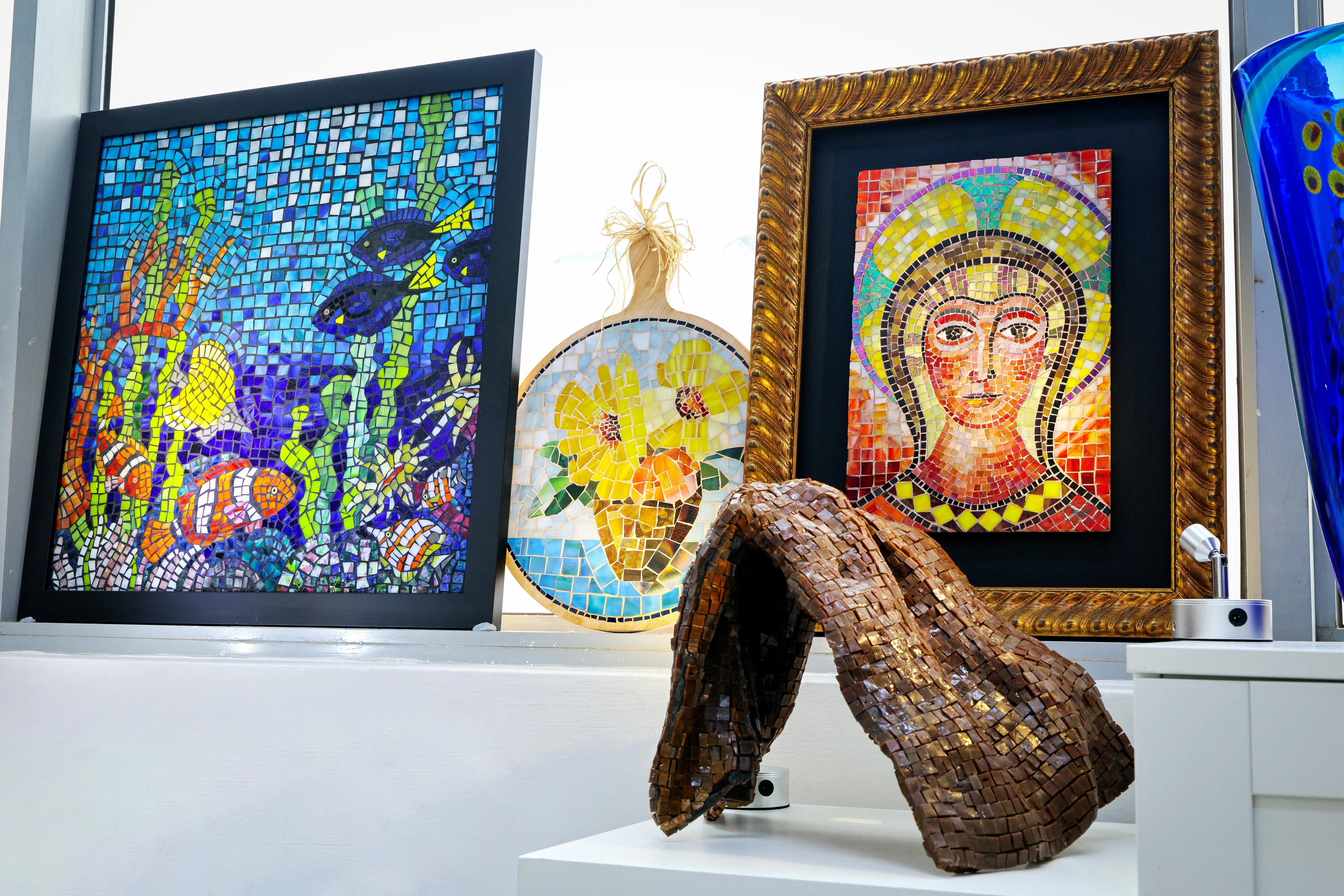
In a floral design using andamento, the pieces spread outwards from the centre of the flower. In an underwater scene, the arrangement gives seaweed a sense of upward movement. For a medieval-style image of Christ, the eyes form the focal point, with the pieces extending outwards along the contours of Christ’s figure. Rather than lining up the pieces neatly in straight rows, movement is created through changing the direction of the pieces, staggering them and varying them in colour. Yong also borrows from oil painting techniques, using mosaics of different shades and textures to suggest highlights, shadows and brushstrokes, giving flat works greater depth.
Bare hands and a resilient spirit
Mosaic-making demands particular patience. A complex work can take a total of 50 to 60 hours, with every small piece of glass needing to be cut, shaped and arranged. Yong works without gloves, believing that direct contact allows her to better feel the texture, pliability and thickness of the glass, and control the pressure she applies when cutting. Using a glass cutter, she deftly scores smooth lines across a sheet, then breaks the glass into shape with her hands. Small mosaic pieces must be snipped with special glass nippers. With a crisp snap, the glass breaks into the smallest units of her art, ready to be glued into place one by one.
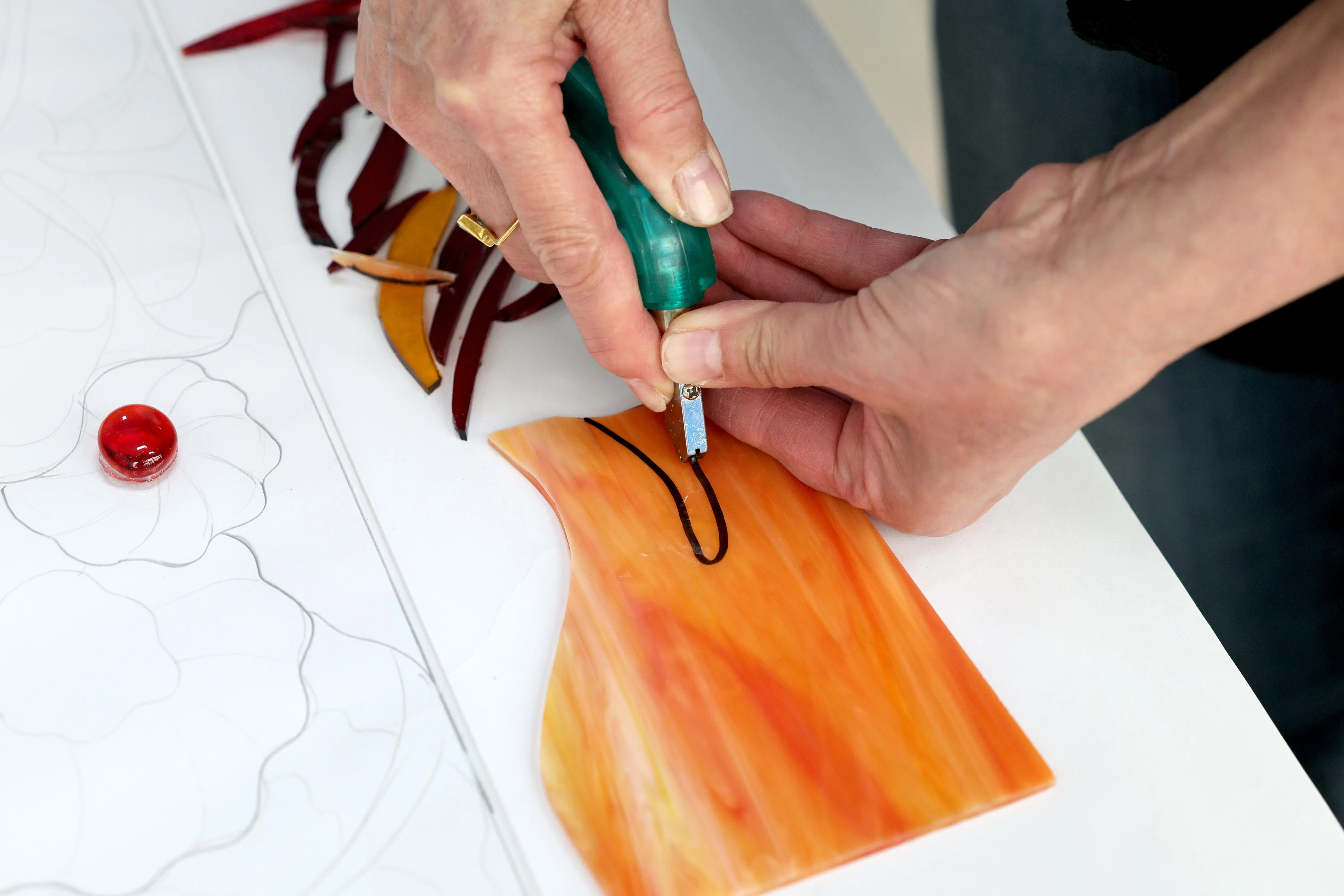
At her regular workshops, Yong also encourages participants to work without gloves and handle the glass directly. “Many people are afraid at first, worried that they will cut their hands. But once they learn the proper technique, they can handle it confidently by the end of a lesson. Once you familiarise yourself with glass as a material, that fear goes away.” Over her many years of working with glass, she has had accidents, but they happened while putting glass away carelessly rather than while creating her work. These accidents do not trouble her. In her hands, glass is more akin to a “partner” with which she brings beauty to life.
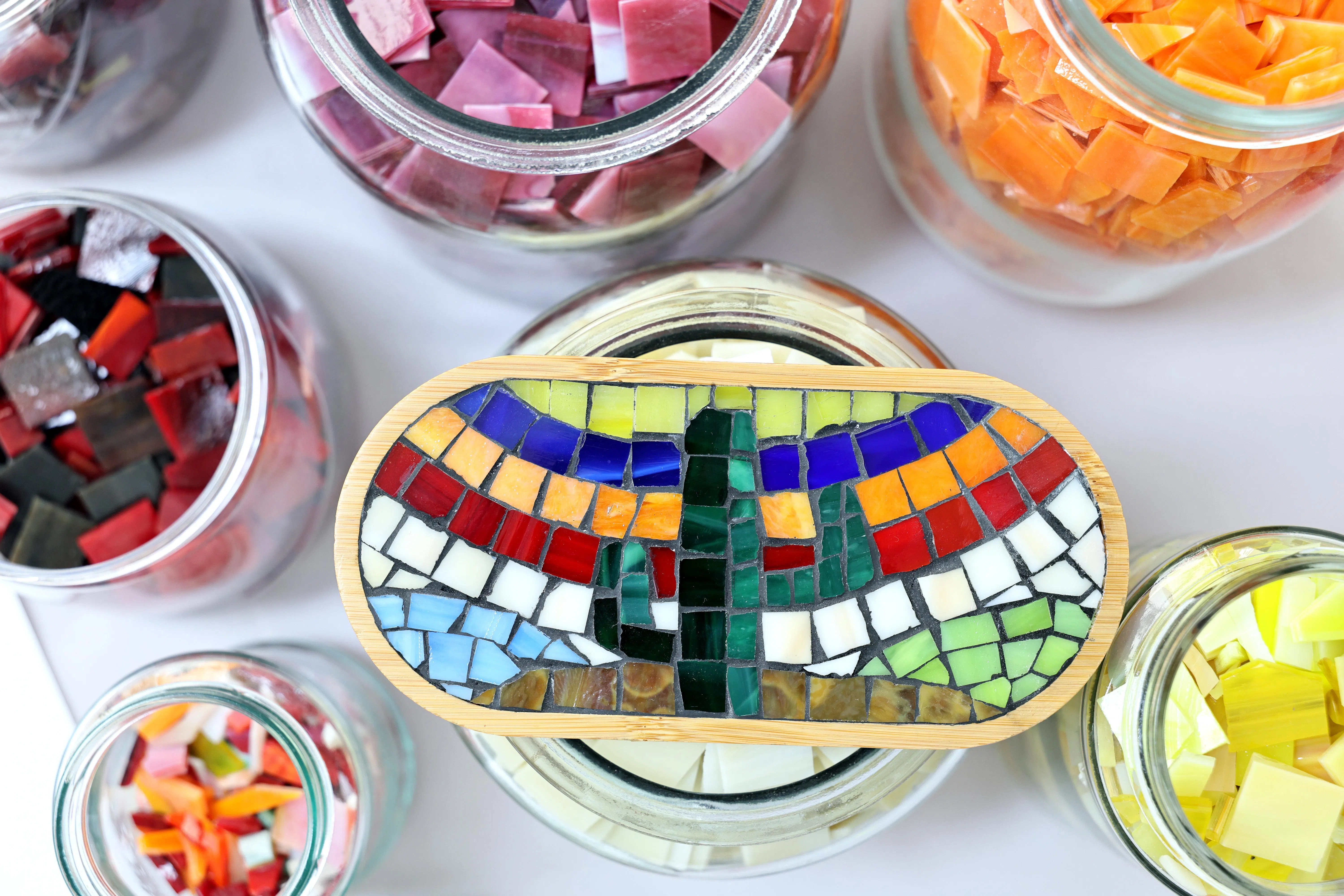
Surrounded as we are today by digital tools, Yong believes the slow pace of glass mosaic art is precisely the experience this age needs. By returning their attention to their hands and the feel of materials, people can enjoy a “digital detox”, allowing their thoughts and creativity to flow freely as they work on their crafts. She opens her studio to participants so they can experience that state of flow through mosaic-making, and has also established a local stained-glass community whose members range from their 20s to their 60s and 70s.
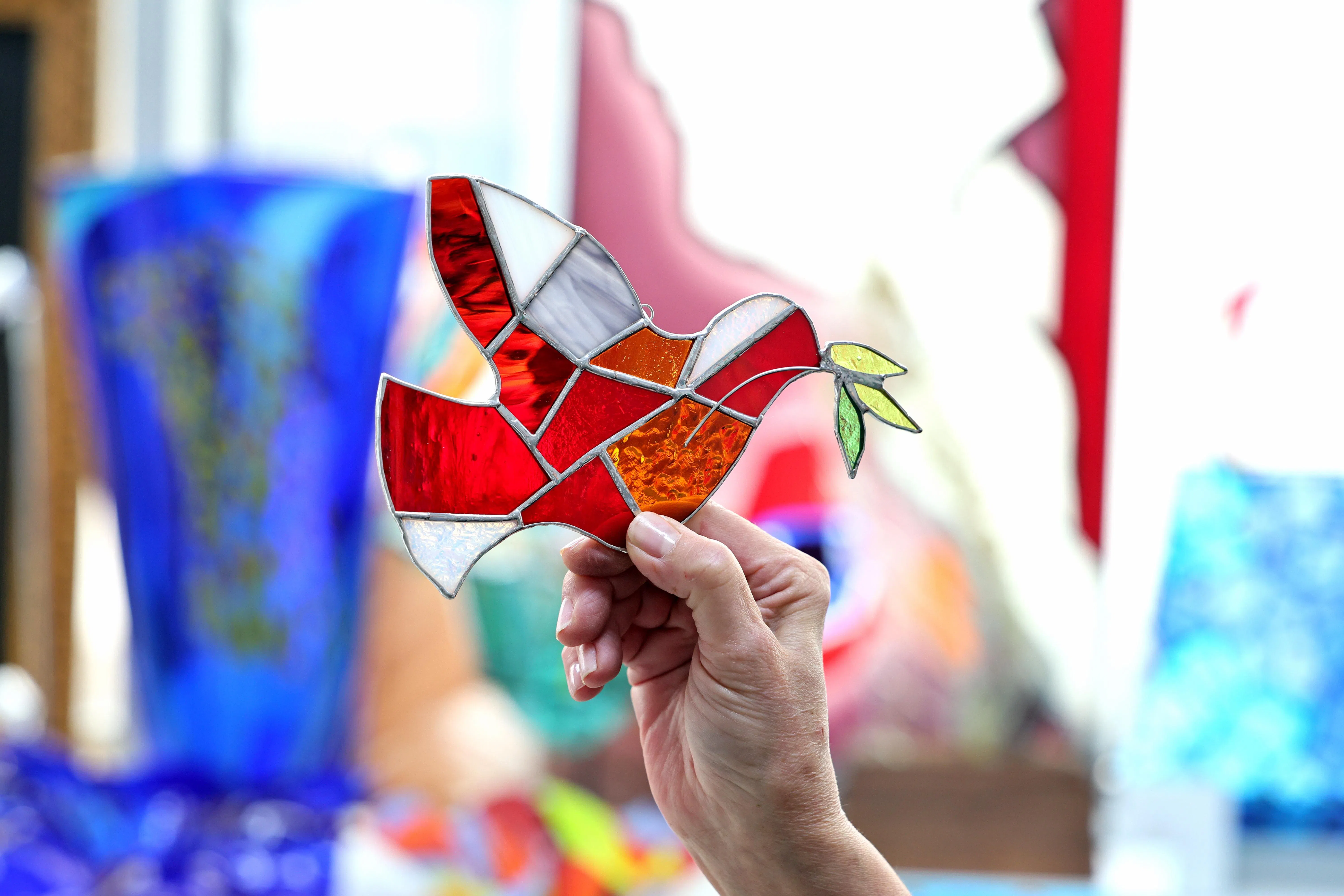
Project Lumen, currently on show at ION Art Gallery on the fourth floor of ION Orchard until 27 October, brings together the work of dozens of members of this community. They have repurposed offcuts left over from glass-cutting into around 200 glass doves, conveying peace, hope and love. Yong said, “Mosaics are like life. Everyone experiences different stages of life, and sometimes we see our own brokenness and feel as though we have no value. But when we find meaning again and come together, we can piece together something beautiful once more.”
A mosaic craftsman in a one-room HDB flat
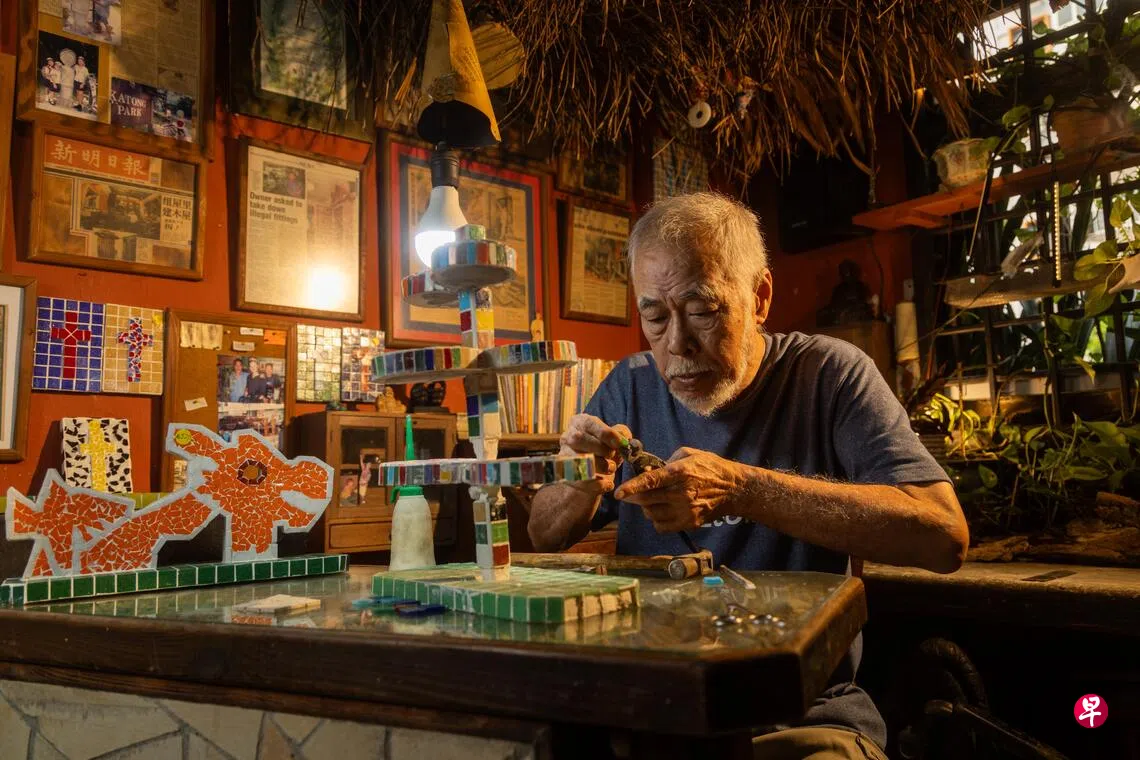
While Yong’s mosaics are rooted in years of professional training, 73-year-old Chow Hon Reng has taken an entirely different path. Stepping into his one-room rental HDB flat on North Bridge Road reveals a space filled with his astonishing and inventive craftmanship. On the walls hang the Chinese characters for “Buddha”, “heart” and “forbearance”, assembled from square mosaic tiles — works he made to cultivate his mind and character. The tables hold distinctively shaped plant stands, wooden houses, flowerpots and models of dragon playgrounds, as well as a triangular lamp. “I made this with the shape of a pyramid in mind. Open the shade and there’s a light bulb inside,” he said, demonstrating it to the reporter.
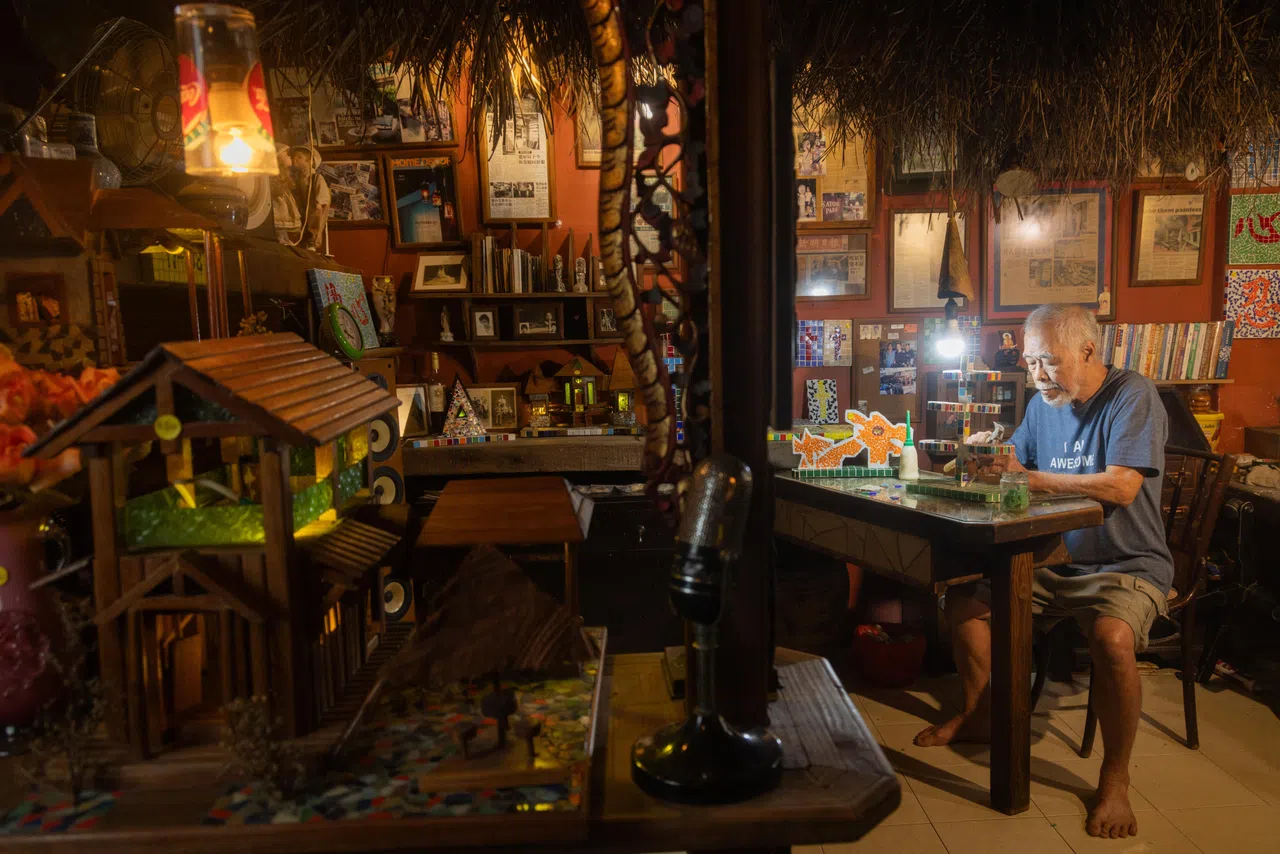
Chow began learning mosaic work when he was young. When he was in Secondary 1, he admired the mosaic work his uncle and cousin were doing in Kuala Lumpur, so he dropped out of school to learn it alongside them. “I’ve been interested in mosaics since I was little. Whenever I saw beautiful mosaic work outside, I would keep peering at it to study it.” The skill later became his livelihood. In renovation work, mosaics have to be laid piece by piece, making the work time-consuming and labour-intensive, so the pay is naturally a little higher. “When I was in my 20s, I earned $15 a day. That was a lot. A lead carpenter earned only $10 then, but I had $15. I could support myself and still have money to spend on my friends,” he recalled.
However, Chow’s impetuous youth took him down many wrong paths. He lived in the area known as Huo Cheng (located in Kallang), joined a secret society and went to prison several times. Looking back, he regrets losing a decade of his life. “If I hadn’t wasted those ten golden years, things might be different now.” Those years were gone, but fortunately his skills remained. He went on to learn carpentry, do renovation work and take on building jobs, earning his living through hard work. The trouble with being handy, he said, is that “my hands can’t stay idle. I always have to be making or repairing something.”
These days, Chow no longer makes mosaics as part of renovation work, but treats them “as works of art” to pass the time. He first cuts glass tiles into fragments, then fits them into his work one by one. After that comes mixing cement, filling the grout lines and tapping the pieces into place. Sometimes the glass tiles do not adhere firmly to the cement, so he has to stick them back on when they fall off. Cuts from the glass tiles are nothing unusual either. When I visited, he was building a cement house on four supporting pillars. He planned to add a removable lid on top, then decorate it with coloured mosaic pieces, a little at a time.
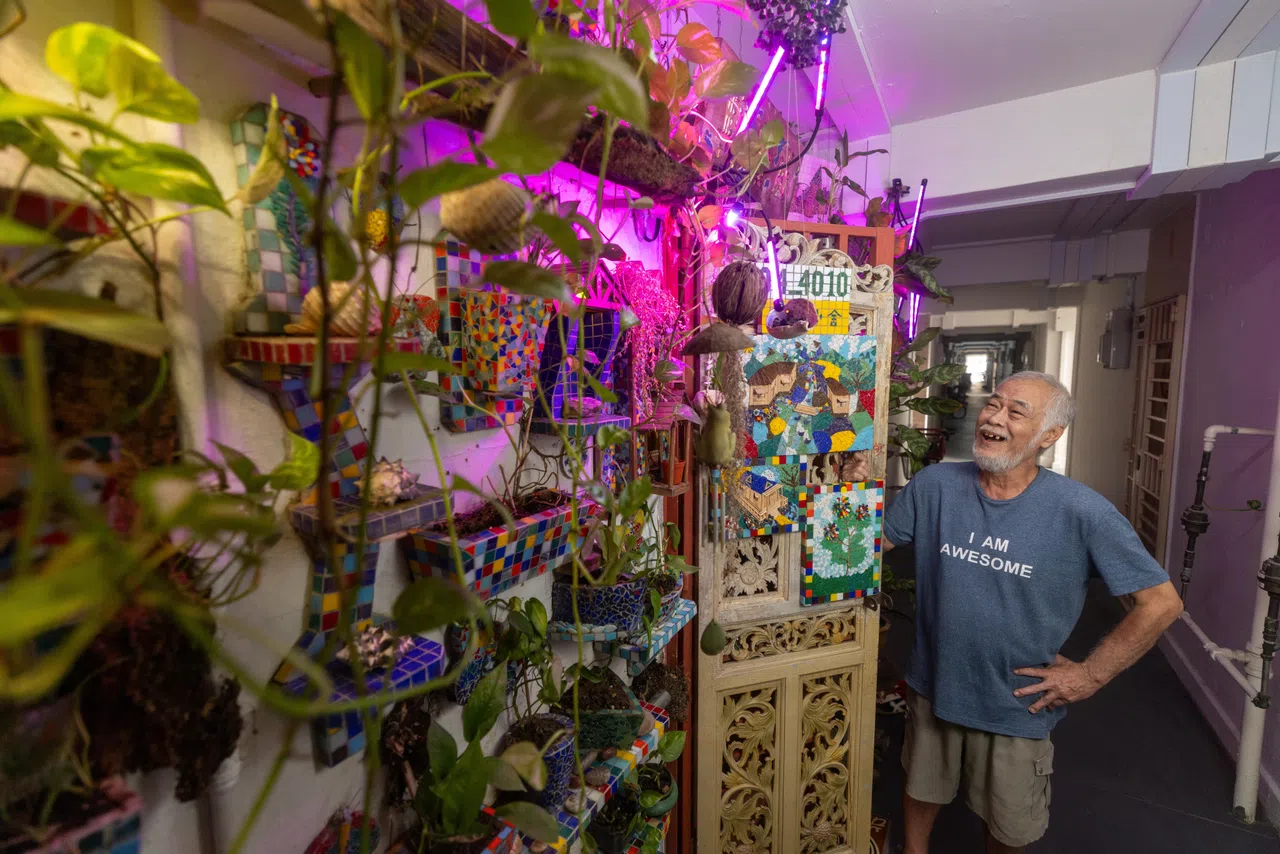
Describing his creative urge, Chow said, “Every creative cell in my body is buzzing. It drives me on; I can’t stop. Making mosaics takes patience. It helps me stay mentally balanced, keeps memory loss at bay and gives me something to focus on. It’s very helpful for older people like us. We don’t dwell on things or sit around doing nothing. Every day is a happy one.”
Bringing HDB memories into modern homes
In the hands of a younger generation, mosaics take on another form. For 37-year-old Chong Huiling Emilia, a love of mosaics began with the tables and seats beneath HDB blocks, whose tiled surfaces are woven into her childhood memories. Growing up in an HDB flat, she often played in the void deck after school. Those tables and seats covered in little square tiles were an everyday sight. “Whenever I see them, they feel so familiar, so much like home.”
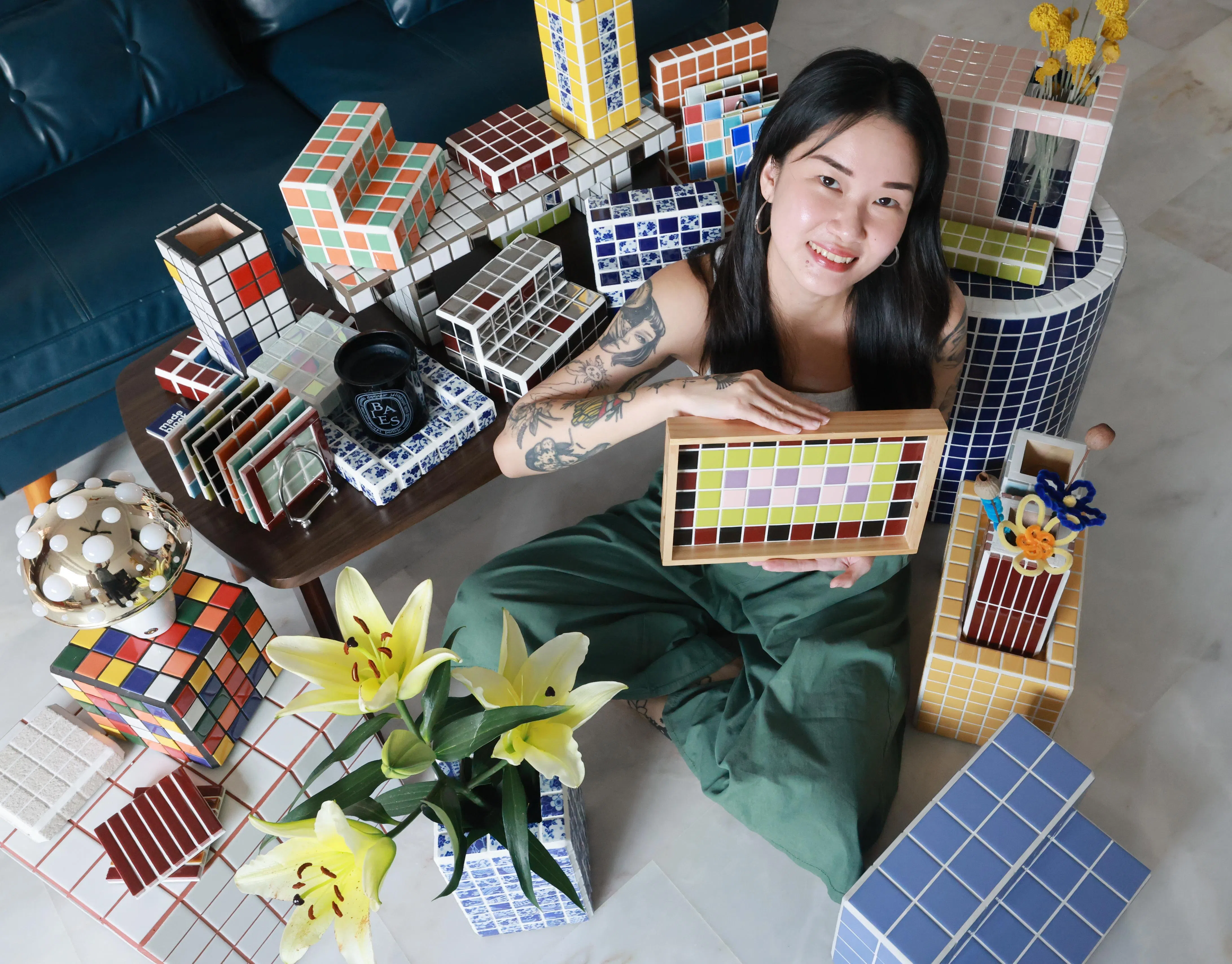
Previously in advertising, Chong started a side business with spare time on her hands during the pandemic, gradually turning her attention to small square mosaic tiles. In 2021, she established her own mosaic design brand, madeblock. When she was subsequently retrenched, she decided to devote herself to it full-time. Laughing, she said her enthusiasm for things had always been short-lived. She never expected to spend four years making mosaics, or to enjoy it more and more.
Chong’s handmade everyday objects range from vases, trays and coasters to display stands for perfume, jewellery and figurines. With simple, stylish designs and the visual appeal of single colours or mixed colour combinations, she has developed a distinctive approach to mosaics. She dislikes repeating a design. Each time, she looks at tiles in various colours, imagines how they will look together and spontaneously comes up with fresh combinations. Traditional mosaics often involve cutting materials into fragments before assembling them into a complete image. Chong prefers to retain the tiles’ square shape, using simple three-dimensional structures and colour combinations to bring a familiar material into contemporary homes.
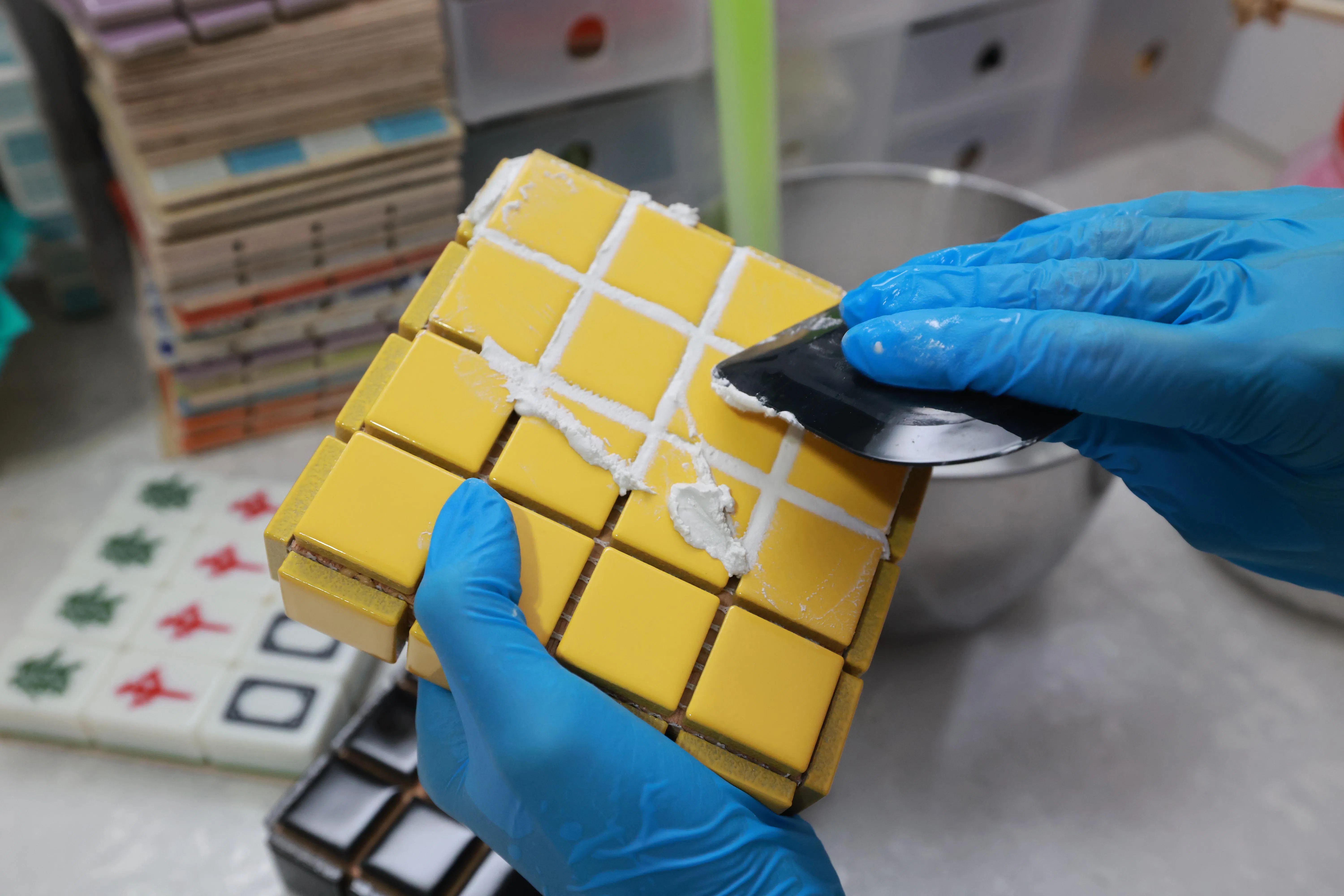
A self-taught mosaic-maker, Chong devised many of her own structures, learning gradually through practice. She glues small square tiles onto a wooden structure one by one, waits for the adhesive to dry, fills the gaps with cement grout, then cleans the surface and leaves it to dry again. Each finished piece takes several stages of work. In March this year, she began running workshops to share the craft with more people. She also takes custom orders. She has received enquiries about making wedding signs, while one customer commissioned mosaic bookends as a gift for their partner. By taking on custom requests, she challenges herself to expand the possibilities of what she can create with mosaics.
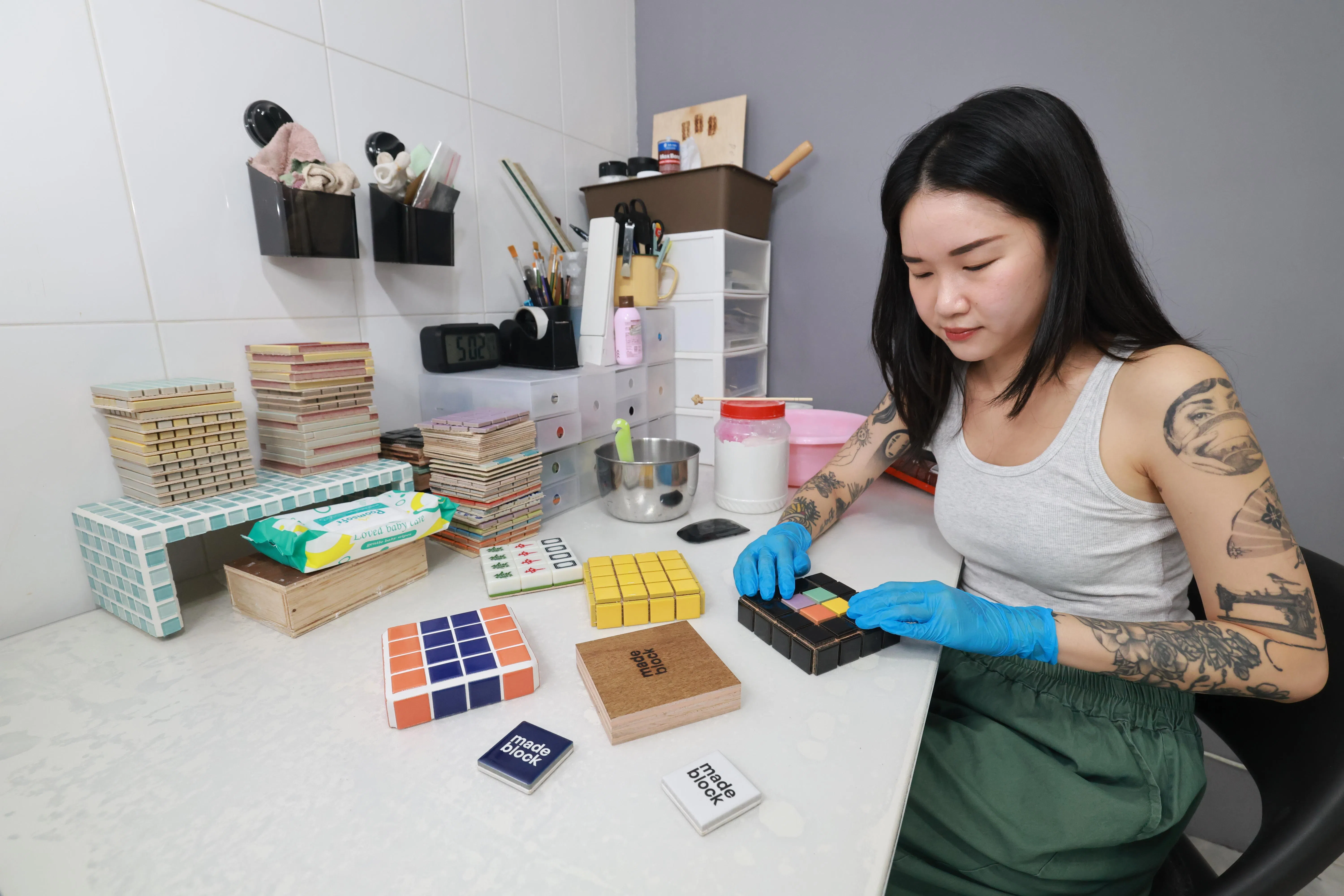
When discussing the aesthetics of mosaics, Chong said that after several years of working with them, she sees them increasingly as a material that never goes out of style. Simple, durable and ubiquitous, these “smallest units of creativity” can be found on walls and floors and in bathrooms and public spaces. Yet, small as they are, their potential is vast. The current revival of nostalgic aesthetics has also brought the colours and textures of the 1980s and 1990s, along with tiles commonly found in older HDB flats and houses, back into public favour. In future, she hopes madeblock will go beyond homeware to take on larger furniture pieces or installations. Through her work with small square mosaic tiles, she hopes to preserve fading memories of HDB life in a different form.
