

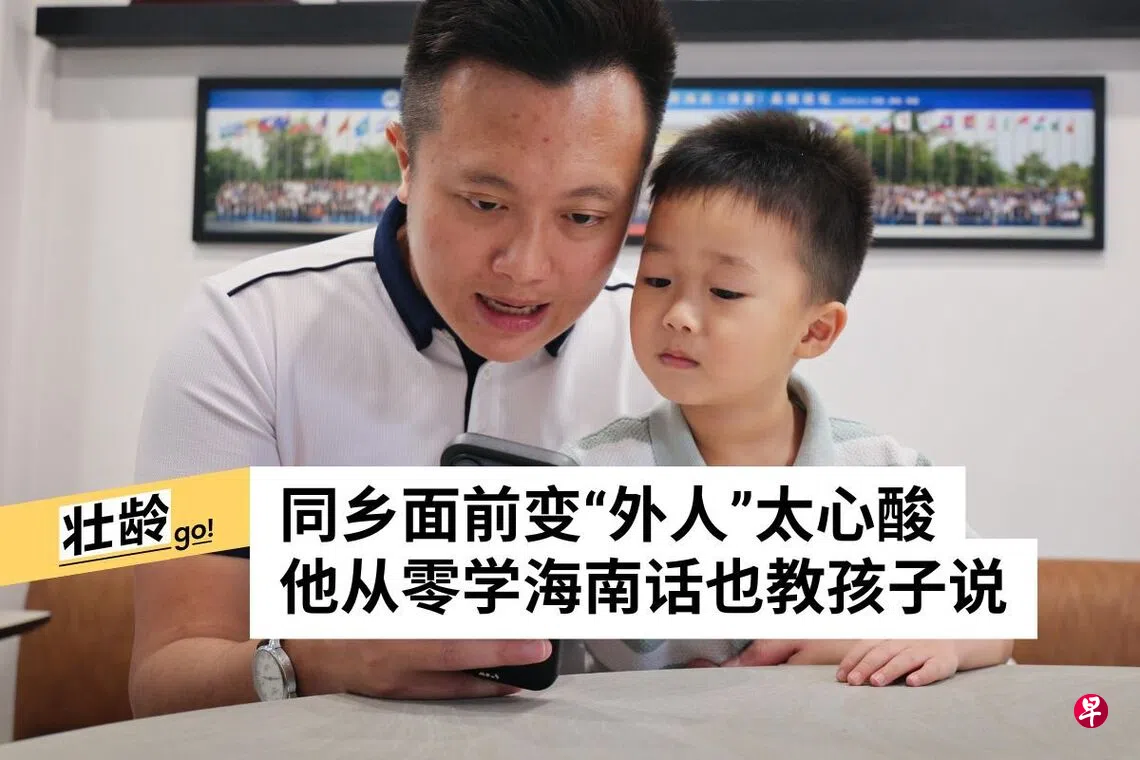
For 34-year-old entrepreneur Eldred Wee, learning Hainanese has never been simply about knowing another dialect.
Wee’s company, Edenity, buys and sells businesses. Speaking to Lianhe Zaobao at the Singapore Hainan Chamber of Commerce, he said entrepreneurship could be a lonely journey. He had hoped to find like-minded people in his social circle and a place he could call “home”, but always felt something was missing.
At the suggestion of a family friend, he joined the chamber more than two years ago. There, hearing a group of people converse in Hainanese, he felt an unfamiliarity he could not quite describe. “This is a language I should know, but I couldn’t understand a word.”
At that moment, he felt as though he were standing at his own front door without a key. He decided to take Hainanese lessons at the Singapore Hainan Hwee Kuan. The class had more than 30 students of different ages, including a few young people like him. It felt like a step forwards, yet also a step back into the past. “My mother asked me why I had suddenly become so interested in Hainanese. Was I hoping to get in touch with my father?”
Wee’s parents divorced when he was nine. He and his three younger siblings grew up with their mother, away from their paternal grandparents, so they did not pick up Hainanese naturally. As he grew older, however, he became increasingly curious about what his ancestors had spoken about and where they had come from.
“If I don’t learn it now, it might really be gone one day,” he said with contemplation.
Finding his roots means facing the past
Learning the language also opened up old family wounds. Searching for his roots, he acknowledged, sometimes meant facing the past. Gradually, however, he came to understand that this journey was not about finding someone, but about finding himself.
Wee said with a smile that Hainanese people were, after all, a minority in Singapore. Few people could teach the language, and there were limited opportunities to use it. Though in class, he met a breast surgeon working at Gleneagles Hospital where almost everyone on her floor spoke Hainanese except her, so her mother accompanied her to lessons.
He does not aspire to speak it beautifully; he simply hopes to be able to communicate with fellow Hainanese. Since learning the language, he has even taken to scanning the surnames on guest lists before business events, looking for others of Hainanese descent to have a chat with. Whether they do business becomes secondary, because along with a shared heritage comes a feeling of kinship.
That sense of closeness is something he is now passing on to his four-year-old son, Eden. The boy was beside him on the day of the interview and could already say a few simple Hainanese words in his endearing way. Listening to him, Wee could not hide his smile, from his pride as a father.
His son began learning Hainanese at two
His son was reluctant to learn the language at first. Even Mandarin seemed difficult, let alone Hainanese. Wee began teaching him when he was two. Recalling the moments they had spent learning Hainanese together, Wee suddenly became a little choked up. “There are so many. I feel like crying just thinking about them.”
Speaking Hainanese with his son, he said, gave him a curious feeling, as though he were talking to his late grandfather. “I never had the chance to speak to him like this.” His grandfather died early, and Wee regrets never having spoken Hainanese with him.
His wife once told him that, watching him with their son, she felt he was not merely teaching the boy Hainanese. It was as though he were also helping the child within himself grow up all over again.
After a brief silence, Wee said, “My father wasn’t around when I was little. No one taught me how to shake hands. But when I took my son to the Hainan Chamber of Commerce, a group of Hainanese elders took it upon themselves to teach him. Those elderly men were like grandfathers to him.”
For Wee, moments like these make the passing on of heritage more tangible than words ever could.
Once, Eden asked him: “What do you do for work?”
Wee told him that he “buys and sells companies”. Naturally, the little boy did not understand. But when Wee was away from home, Eden would tell his mother: “Daddy works at the Hainan Chamber of Commerce.”
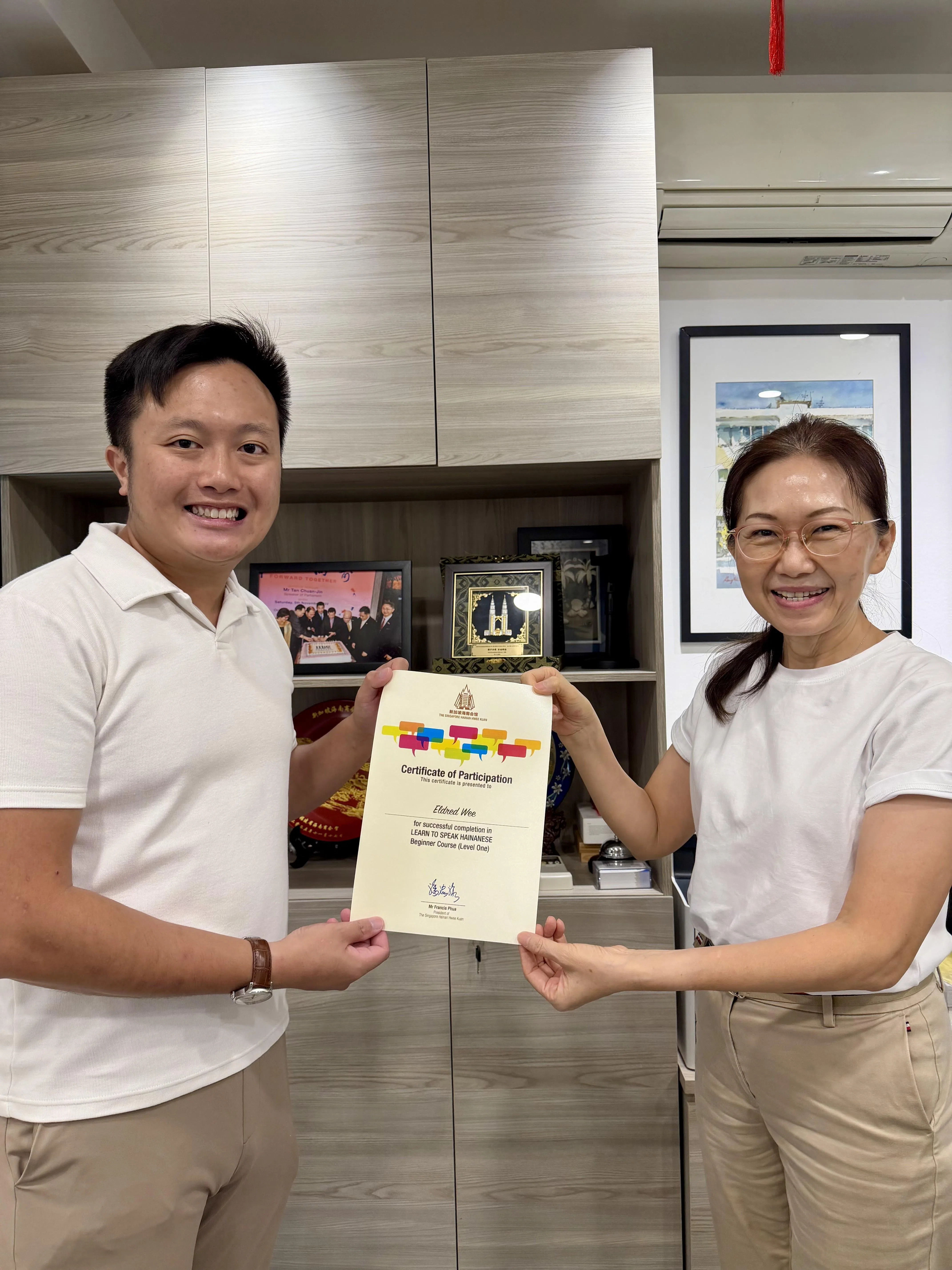
Wee found this both amusing and touching. His son might not yet know what his father did for a living, but he already knew what the Hainan Chamber of Commerce was. “I only started speaking Hainanese at 32. He’s starting as a child. In 12 or 20 years, might he become part of a new generation of Hainanese?”
A language rooted in identity and belonging
For Wee, the greatest value of Hainanese has never been its practical usefulness, but the sense of identity and belonging it brings. Language is like a key that unlocks the stories his ancestors left behind: Why did they leave their homeland? Why did they come to Singapore? And how did they put down roots here?
He therefore plans to take his family, including his mother, younger brother and younger sister, to Hainan Island to explore their roots. “If you really want to know who you are, you have to dig deeper.”
Wee is now active in the Hainan Chamber of Commerce, helping to promote Hainanese culture. He wants young people to know that it encompasses more than Hainanese chicken rice, with many little-known stories waiting to be told. Passing on a culture need not be a solemn undertaking, he said. It can be “a little more fun”, to encourage the younger generation to take an interest.
Money is certainly not all he wants to leave his son. “I hope that one day, he will know his culture and his roots, and where his father, grandfather and great-grandfather came from.” His eyes grew moist as he spoke.
Perhaps this is what he truly hopes to pass on by learning Hainanese: that his child will still know where he comes from when he grows up. And Wee himself can finally turn back, take the hand of the little boy he once was — who grew up without his father beside him and without the chance to speak Hainanese — and go home together.
After weathering life’s many journeys, we discover the beauty of our prime years. Explore Zhuangling go! specially curated content and join the Zhuangling go! community to make the most of life’s second half together.
