

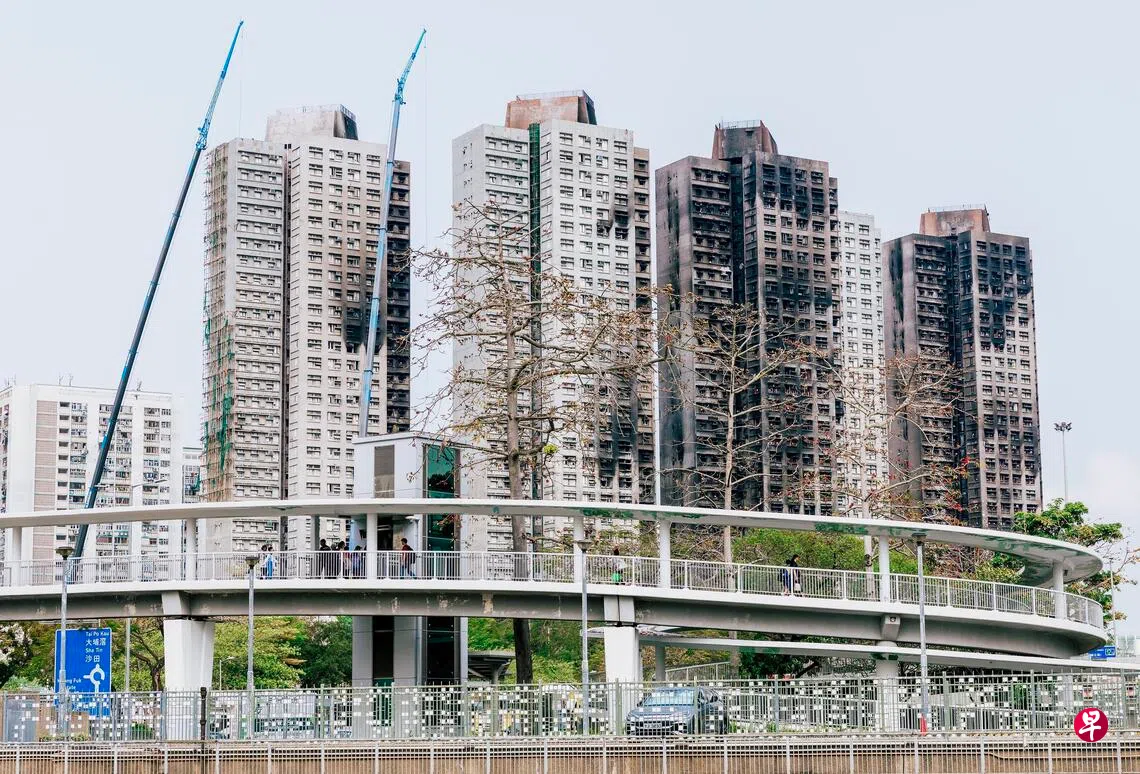
Last year’s devastating fire at Wang Fuk Court in Tai Po exposed serious gaps in Hong Kong’s oversight of building maintenance works. Just a year later, a contractor has been found to have installed fire-resistant doors without the corresponding frame components when replacing lifts in residential buildings, once again ringing alarm bells over the government’s regulatory system for construction projects.
According to Hong Kong’s Electrical and Mechanical Services Department (EMSD), the missing lift door frames came to light after it received a whistleblower report in mid-October. It immediately conducted surprise inspections of lift replacement works undertaken by Taizoom Elevator (Hong Kong) at Tsui Ping (North) Estate in Kwun Tong and Pok Hong Estate in Sha Tin.
The replacement of nine lifts at Tsui Ping (North) Estate had only been completed between February and July this year, while work on replacing 39 lifts at Pok Hong Estate ran from May last year to July this year. Taizoom had submitted fire-resistance test reports stating clearly that everything met the required standards.
But when EMSD officers visited the sites, they found that although the fire-resistant doors had indeed been installed, the critical frame components were missing. In theory, lifts without these frames remain safe in everyday operation. In a fire, however, flames and thick smoke could spread upwards through the lift shafts, creating the “chimney effect” that is one of the greatest dangers in a high-rise fire.
The EMSD was certainly quick to respond. It immediately ordered Taizoom to install the missing components within a month and referred the case to the police. Officers soon arrested three men on suspicion of fraud: the person in charge of the company and two registered lift engineers.
Yet a far more alarming discovery was to follow. Within three days, the authorities inspected all 376 buildings across Hong Kong where Taizoom had been involved in installing lifts. They found the same omission — missing fire-resistant door frames — in 338 buildings, or more than 90% of the total. In other words, Tsui Ping (North) Estate and Pok Hong Estate were not isolated cases. This was standard practice at Taizoom. The company appeared to believe that as long as it could produce test reports, “details” such as door frames could be dispensed with.
What began as a case involving just two housing estates expanded to encompass 338 buildings across Hong Kong. The scale is staggering. At stake is the safety of hundreds of thousands of residents who use these lifts every day. Many Hong Kong residents said their hearts sank when they read the news, which inevitably brought back memories of the Wang Fuk Court fire.
Last year, all eight residential blocks at Wang Fuk Court were undergoing major maintenance works at the same time, with scaffolding, protective netting and waterproof tarpaulins covering the entire estate. When fire broke out on the afternoon of 26 November, flames quickly spread upwards along the scaffolding netting on the external walls and some materials suspected of failing to meet flame-retardant standards. Almost all eight blocks were engulfed.
Despite the Fire Services Department deploying more than 200 fire engines and over 1,200 firefighters, the blaze burned through the night before it was brought under control, killing 168 people. Hong Kong Chief Executive John Lee subsequently announced the establishment of an independent committee to investigate.
Subsequent investigation reports and expert hearings revealed numerous shocking facts. For example, the contractor was suspected of falsifying the test reports it submitted to the government for the scaffolding netting used at Wang Fuk Court. Different batches of materials at the same site varied enormously in their flame-retardant performance. Some samples continued burning after being ignited, dripping like candle wax and allowing the fire to spread.
Hong Kong is densely populated, with scarce land and closely packed buildings. Lifts and fire safety equipment in many residential blocks require regular maintenance or replacement. Government departments have long confined their role to setting and enforcing the rules for building maintenance works. Contractors carry out the work, while professionals supervise it or sign it off. Incorporated Owners (IO) and property management companies have to make decisions about contracts, costs and work schedules.
These stakeholders, however, do not have equal expertise or access to information. Ordinary residents may not be able to judge whether the equipment and materials used meet specifications, nor can they readily tell from appearances alone whether work has been completed as required. Even if IOs are willing to monitor the work, they may lack the expertise to verify every technical detail.
Over the years, the Hong Kong government and residents have therefore gradually come to rely on a passive regulatory model of contractor self-regulation and document approval. Under this system, government departments have limited manpower and cannot visit every site to recheck every job and component. As long as professional bodies or individuals submit a complete set of documents and satisfactory reports, that is deemed sufficient.
The problem is, once unscrupulous industry practitioners are involved, the loopholes in this system are magnified. Especially as Hong Kong’s construction sector has developed an interdependent web of interests in recent years, professionals are, in theory, supposed to uphold their professional integrity and the public interest. In practice, however, some are heavily influenced by the view that business interests come first. The result has been repeated failures of regulatory oversight and professional judgement, and frequent construction incidents.
Whether it is the scaffolding netting at Wang Fuk Court or Taizoom’s fire-resistant door frames, the same fundamental failing is exposed: contractors submit supposedly compliant paperwork, which government departments and IOs often accept at face value. Rarely do they visit sites to check carefully whether the work matches the documents. On the surface, this may look like negligence by individual contractors. In fact, it is a structural problem arising from professional services becoming just another business.
Public confidence in Hong Kong’s regulatory system was already shaken by the Wang Fuk Court fire. The elevator cases further demonstrate that even when work is carried out by specialist contractors and backed by test reports, an effective verification mechanism is still essential. It is another reminder to the Hong Kong government that building safety cannot be a matter of appearances. Genuine reform means moving oversight to an earlier stage, making such failings harder to occur.
