

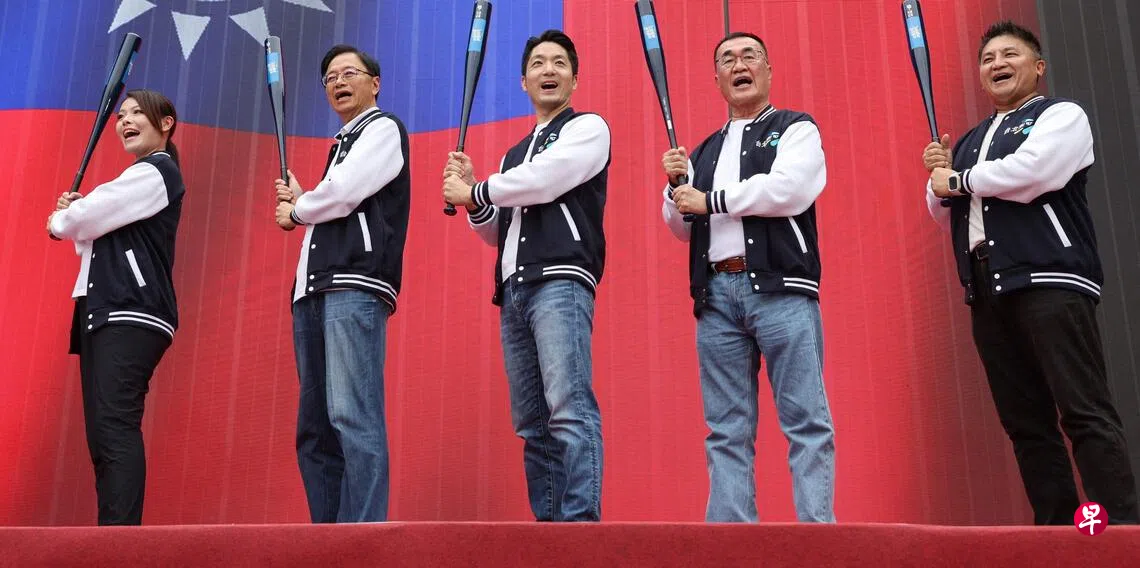
Under mounting pressure from a rival, Taipei Mayor Chiang Wan-an of the Kuomintang (KMT), said he would not reinvent himself for his election campaign, describing himself as down-to-earth and focused on running the city rather than on image-making or theatrics.
Seeking re-election, he apologised to his supporters who were worried about his chances, as he urged them to speak up without fear and declared the start of a campaign fightback.
Chiang held a rally to launch his campaign headquarters on Monday (26 October), with senior KMT figures gathering to show their support. They included Taichung Mayor Lu Shiow-yen, who chairs his campaign team, New Taipei Mayor Hou Yu-ih, and Legislative Yuan Speaker Han Kuo-yu. The appearance reunited the trio, nicknamed “Swallow”, “Tough Guy” and “Baldy” respectively. KMT chairwoman Cheng Li-wun and Taiwan People’s Party chairman Huang Kuo-chang appeared as “mystery guests”. Both left after delivering their speeches without sharing the stage with Chiang. Organisers said 50,000 people attended.
Prominent Taiwanese television host Kevin Tsai, who sparked controversy when he appeared at the recent campaign headquarters launch of Democratic Progressive Party (DPP) Taipei mayoral candidate Puma Shen, also attended as promised. He arrived in a black suit, then removed his jacket to reveal a white shirt that matched the rally’s dress theme. He sat in the audience and left only after Chiang finished speaking.
Speaking to reporters, Tsai praised Chiang’s speech as “very heartfelt”, saying it conveyed passion and hope to everyone present.
Chiang had been widely favoured to win re-election in this year’s nine-in-one local elections. But recent opinion polls show that DPP candidate Shen has caught up with him and even taken the lead, thus shifting the dynamics of the Taipei mayoral race. Some supporters of the pan-Blue KMT camp have questioned Shen’s move to appear more caring and approachable ahead of the election, after previously backing the “mass recall” movement, saying they find the stark contrast difficult to accept.
In a pointed remark during his speech on Monday, Chiang said he would “not resort to sophistry”, was “not good at image-making and theatrics”, and would not “create a special new persona” for an election. He stressed that he did not believe “an ever-changing persona will earn people’s trust”.
Outlining his record in office, Chiang cited securing Nvidia’s decision to establish a base in Taipei, introducing free school lunches, working towards a smoke-free city and starting construction on six metro lines. He said his focus was on Taipei’s development over the next 20 years.
He accused the DPP government of deploying extensive administrative resources and its election machinery against opponents. Rather than reflecting on last year’s failed mass recall campaign, he said, “everyone from [President] Lai Ching-te to [Premier] Cho Jung-tai is thinking only about elections and ignoring people’s livelihoods”. He also accused the government of “letting people consume toxic cooking oil” and opposing tougher penalties for child abuse, subsidies for older people’s health insurance premiums and pay rises for military personnel.
Chiang urged supporters to come forward without fear, declaring that the launch of his campaign headquarters “formally sounds the call for a fightback”.
Han, known for his memorable turns of phrase, said while campaigning for Chiang that more than 90% of Taiwan’s media outlets and online commentary were concentrating their attacks on the mayor. Such an onslaught, he said, “would turn an angel into a devil, whoever it was directed at”. He also urged Lai, who had himself been targeted by online trolls, to act according to his conscience. Drawing an analogy with the use of stun batons in Myanmar’s scam compounds, he criticised the practice of making opposition candidates “scream under electric shocks” at every election, saying, “This is not democracy.”
In an interview, Chen Shih-min, a professor of political science at National Taiwan University, said Chiang had previously taken a relatively low-key approach to the campaign. Only when recent polls showed Shen closing in did he begin campaigning actively, missing the opportunity to prepare early. Chen commented that Chiang should avoid losing further ground over municipal controversies and give specific, convincing answers that demonstrate his grasp of city affairs and his vision for the next four years. This would help dispel the perception that he lacks resolve in governing.
Chuang Po-chung, a former head of the KMT’s Culture and Communications Committee and party spokesman who is now a journalism professor at Chinese Culture University, said it would be difficult for the KMT to lose in Taipei. Should Chiang suffer an upset defeat, “his political career would take a major blow” and it would be harder for the KMT to regain the city in future. Even a narrow victory would leave him with little political momentum to pursue the presidency, limiting him to serving out another four-year term as mayor.
As for the gathering of senior KMT figures in support of Chiang, Chuang said their fortunes were intertwined. Whatever their individual political calculations, none of them stands to gain from a collapse in KMT support. He said the nine-in-one local elections were a precursor to the 2028 presidential election. A poor KMT showing would not only complicate preparations for the next presidential contest, but could even trigger an internal leadership challenge and a restructuring of power within the party.
Among those supporters who travelled from New Taipei specifically for Monday’s campaign headquarters launch was Wu, 43, who wanted to give Chiang a morale boost as the race tightened. He disagreed with Shen’s past support for the mass recall campaign, which he believed had deepened divisions in Taiwanese society. “Everyone has their own views, but we must not stir up confrontation or division.”
Wu said Chiang deserved credit for achievements such as the Nvidia push and steps towards a smoke-free city, and that the mayor could have better conveyed these efforts to the public if he were a more eloquent speaker.
Hsu, who has an eight-year-old son, praised Chiang’s handling of a food-safety controversy involving school lunches, saying he had not evaded the issue but had actively explained the situation to parents. He also hoped Chiang would show greater toughness and resolve when facing attacks from his opponent.
