

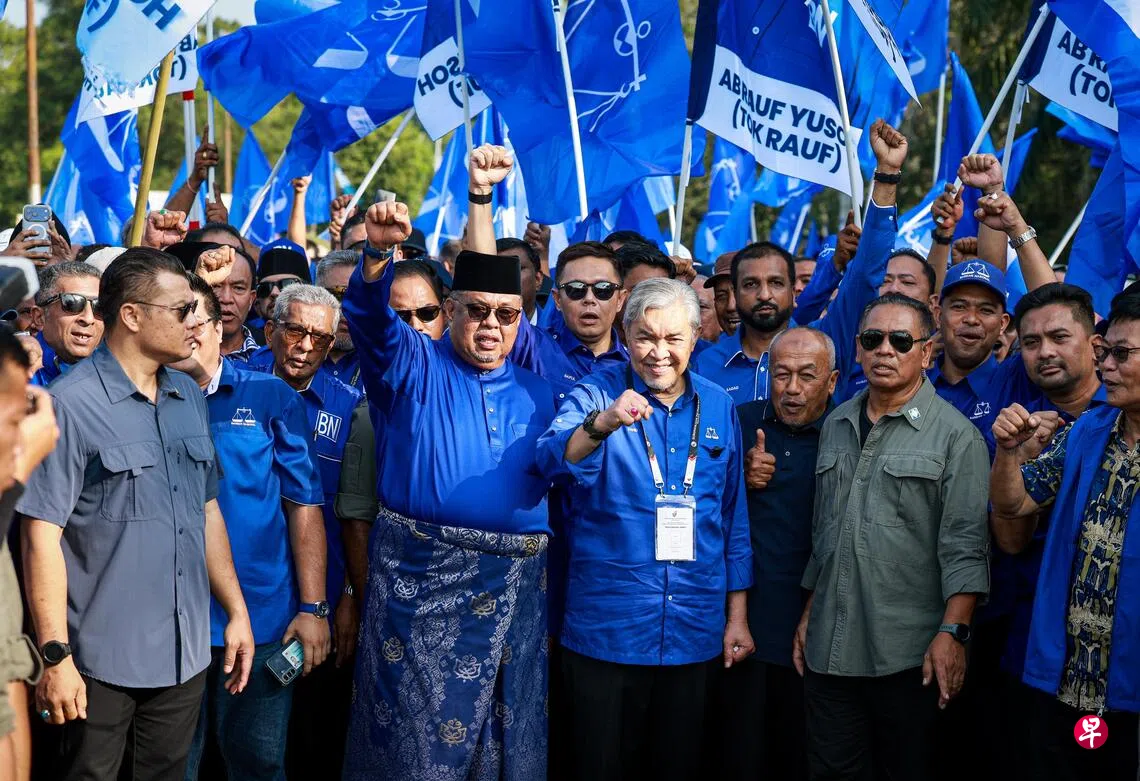
Nominations have closed for Malaysia’s 16th Melaka state election, with 79 candidates vying for 28 state assembly seats and multi-cornered contests in 17. Beyond the contest for seats, the election is an important test of cooperation between political camps, and its results could set the tone for alliances at the next general election.
The Melaka state assembly has 28 seats, with 15 needed to form a government. Polling day is set for 14 November.
Malaysian Election Commission chairman Ramlan Harun held a press conference after nominations closed on Saturday (31 October). He said 11 constituencies would see straight fights, 11 would have three-way contests and six would have four-way contests.
No single coalition or party is contesting all the seats. Pakatan Harapan (PH) is contesting 24, the most of any coalition, while Barisan Nasional (BN), which previously governed Melaka, is contesting 23. The Parti Islam Se-Malaysia (PAS)-led Perikatan Nasional (PN) is fielding candidates in five constituencies, while PN member Parti Pribumi Bersatu Malaysia (Bersatu), which has split with PAS, is contesting seven seats.
Among the other parties, Parti Bersama Malaysia (BERSAMA) is contesting 16 seats and Parti Bumiputera Perkasa (PUTRA) one. Three candidates are standing as independents.
Analyst: PN makes concessions to gain bargaining leverage for general election
The Melaka election marks the third time BN and PN have teamed up, following the Johor and Negeri Sembilan state elections. The two sides formally became strategic partners on 28 October, continuing to campaign under the banner of “Malay unity” in a bid to consolidate Malay votes.
Analysts see the PAS-led PN’s decision to contest just five seats as a concession and a gesture of goodwill towards BN and UMNO chairman Ahmad Zahid Hamidi. PAS and Parti Wawasan Negara (WAWASAN) are each fielding two candidates in these five seats, while Parti Gerakan Rakyat Malaysia is fielding one.
Compared with PN, BN is strong at state level but weak at parliamentary level in Melaka. In the 15th Melaka state election in 2021, BN won 21 seats and PN two. In the 2022 general election, however, PN won three of Melaka’s six parliamentary seats, while BN won none.
Malaysian political scientist Phoon Wing Keong told Lianhe Zaobao that PN’s acceptance of BN’s proposed seat allocation for this state election could be aimed at securing more parliamentary seats to contest under the same principle at the next general election.
Bersatu and PH may be paving the way for cooperation
Interactions between PH and Bersatu have also drawn attention. Of PH’s candidates, 10 are from Parti Keadilan Rakyat (PKR), with seven each from Parti Amanah Negara and the Democratic Action Party (DAP). DAP had initially planned to contest eight seats but eventually ceded the Bemban state seat to Bersatu.
Although PH and Bersatu have not formally announced an alliance and are going head-to-head in four constituencies, they are widely seen as having reached some degree of cooperation for this election.
Tan Teik Cheng, vice-president of BN component party the Malaysian Chinese Association (MCA), criticised the arrangement, saying that while PH and Bersatu appeared to be competing, PH was in fact using Bersatu to draw Malay votes to benefit PH candidates.
Thirteen Bersatu Members of Parliament signed a confidence and supply agreement on 29 October, pledging to support Prime Minister Anwar Ibrahim’s government until the end of the current parliamentary term. This has also fuelled speculation that PH and Bersatu may be laying the groundwork for future cooperation.

Attention turns to Chinese voters
PH suffered a setback in last November’s Sabah state election and another in this July’s Johor state election, with DAP losing significant support among Chinese voters. This is generally attributed to voter dissatisfaction with PH’s performance in federal government.
In the Negeri Sembilan state election in August, BN and PN’s emphasis on “Malay unity”, combined with the loss of Chinese votes, further eroded support for PH.
Speaking to reporters at a nomination centre on Saturday, DAP national strategy director Liew Chin Tong acknowledged that, after a series of state elections, the Melaka contest was undoubtedly an “uphill battle” for PH.
Meanwhile, MCA has seen signs of voters returning to the party in recent state elections. However, BN initially allocated it only two seats for this election, leaving the other five to PN, a move that upset some Chinese voters.
MCA was subsequently allocated two additional seats, the DAP strongholds of Bandar Hilir and Kota Laksamana. These two constituencies will be closely watched for indications of how Chinese voters cast their ballots.
Lew Wei Cheng, an assistant professor in the Department of Journalism and Political Science at Malaysia’s Universiti Tunku Abdul Rahman, said the state election was a platform for parties to test models of cooperation. If they perform well, cooperation between BN and PN, and between PH and Bersatu, could continue into the next general election.
