

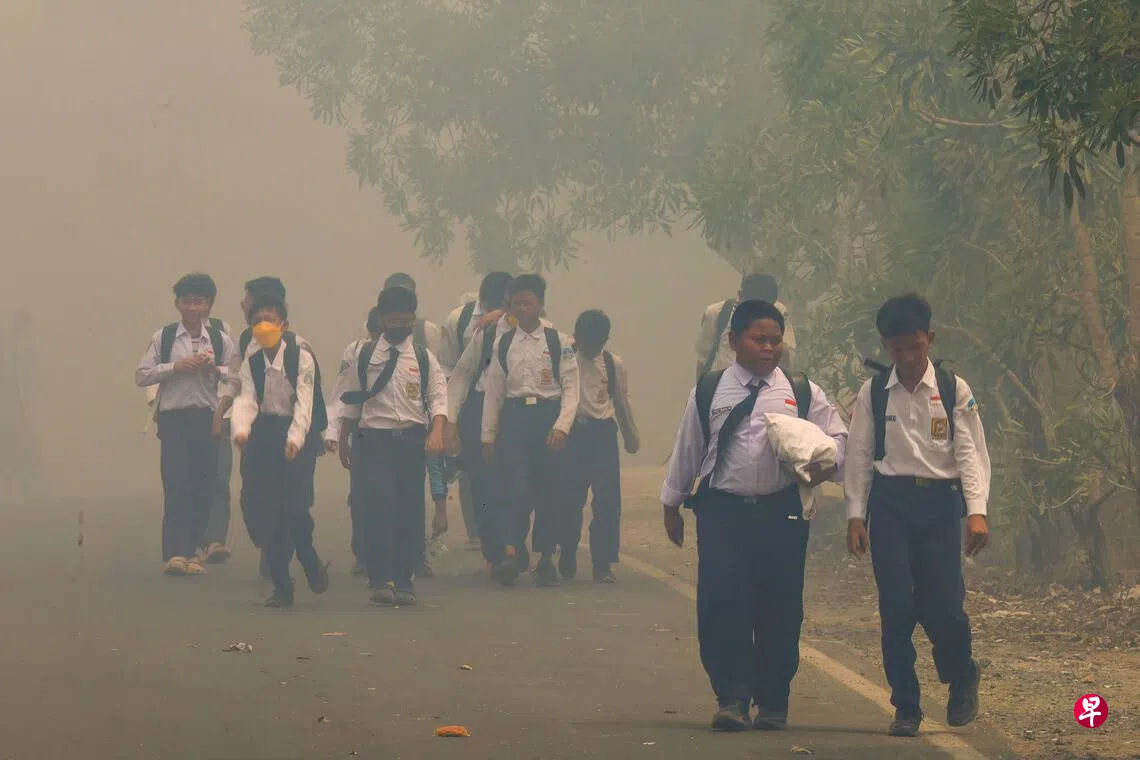
Severe air pollution from forest fire haze in Indonesia caused an estimated 3,500 deaths or more in September, according to a new independent study.
The Finland-based non-profit Centre for Research on Energy and Clean Air (CREA) released a report on Thursday (29 October), saying that about 57.8 million people across Indonesia were exposed to air pollution at unhealthy to hazardous levels in September.
“Worsening air quality due to forest and land fires in Indonesia pushed the estimated death toll to 3,560 cases in September 2026, a twofold increase from the August estimate.” The study primarily estimated deaths caused by short-term exposure to PM2.5 fine particulate pollution.
Including an estimated 1,750 additional deaths caused by pollution unrelated to forest fires, such as emissions from power plants, industry and transport, Indonesia’s estimated air pollution-related death toll in September reached 5,310.
The report said PM2.5 pollution levels across Indonesia in September were more than seven times the World Health Organisation’s annual air quality guideline level. Levels in Sumatra were 10 times the guideline, while those in Kalimantan were even higher, at 24 times.
Forest fire haze accounted for 94% to 99% of air pollution-related deaths in four Kalimantan provinces. The proportion also exceeded 80% in several provinces in Sumatra. On densely populated Java, 73% to 80% of such deaths were linked to pollution sources unrelated to forest fires, including industry, transport and waste burning.
According to Indonesia’s health ministry, as of 21 October, several areas affected by forest fires had reported a total of 333,470 cases of acute respiratory infections linked to the fires.
Agus Sari, chief executive of consultancy Landscape Indonesia, criticised the government’s inadequate preparedness. He said the disaster could have been foreseen and prevented, while budget cuts at the National Disaster Management Agency had also weakened its response capacity.
“Indonesia should be able to prepare for what is going to happen. The fact that we are not prepared at all is purely a matter of lacking the will.”
The Indonesian government stressed on Wednesday (28 October) that it had mobilised more than 72,000 people for cloud-seeding and firefighting operations, deployed more than 2,100 healthcare workers to the worst-hit areas and distributed 5.3 million masks.
Indonesian meteorological authorities said satellite monitoring indicates that the rise in hotspots across the three worst-hit provinces may gradually slow down, expressing hope that the crisis can be brought under control by next month.
Meteorologists expect rainfall to increase in November and intensify further in December, helping to contain forest fires in Kalimantan and Sumatra. However, whether peatland fires can be extinguished will depend on sustained rainfall covering large swathes of the affected areas.
Separately, the Jakarta Globe reported that Indonesia’s National Police Criminal Investigation Agency chief Asep Safrudin said on Thursday that police were investigating 97 companies suspected of causing forest fires. They included 22 foreign companies, nine with links to Singapore and eight with links to Malaysia.
So far, 20 companies, including four foreign firms, have been named as suspects. Police have also named 245 people as suspects in 287 forest fire cases.
Cases involving corporate entities account for about 29,169 hectares of burnt land, and the police have recommended that the authorities revoke the business licences of 23 companies.
Safrudin said more companies could be implicated as investigations progressed, and that the authorities would hold accountable those who deliberately started fires or caused them through negligence.
