

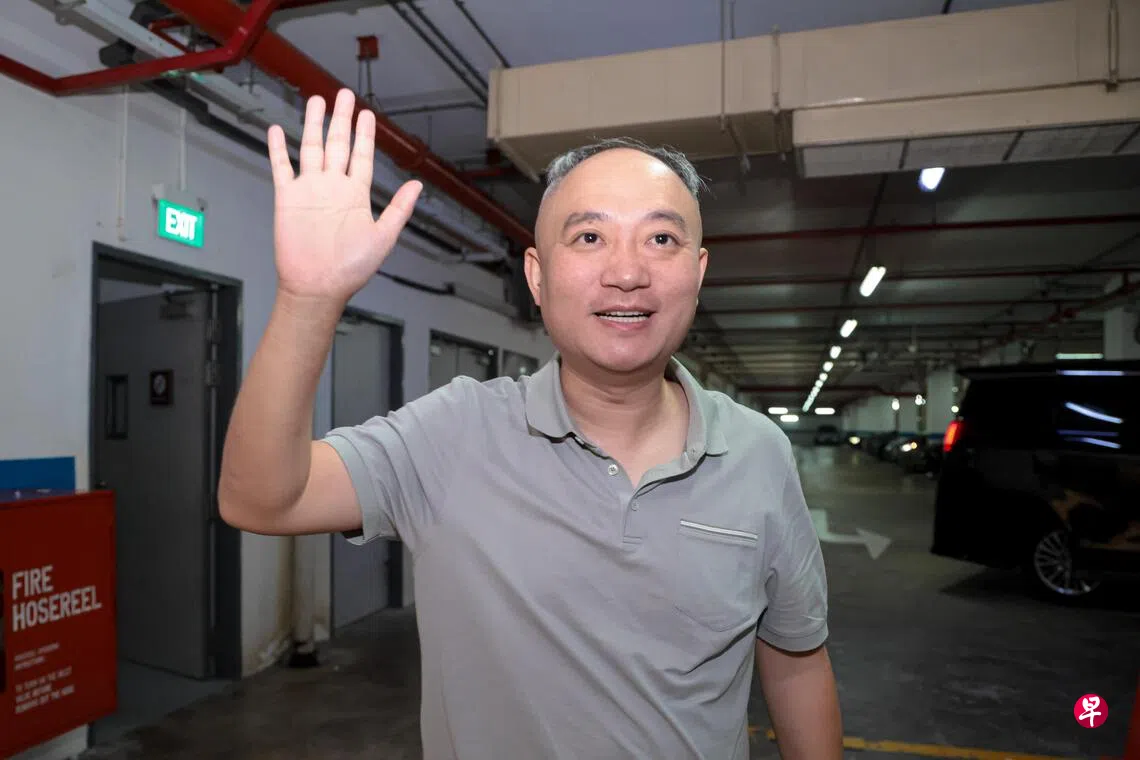
A Chinese tycoon suing four former employees in Singapore testified that he trusted Singaporeans so much that he left his money in their hands to manage and invest, even signing documents they presented without reading them. He alleged that the four had misappropriated S$73 million.
The plaintiff, Zhong Renhai, who said his English was poor, testified in Mandarin on Thursday and Friday (29 and 30 October) that one of the defendants, Goh Sock Ngee, frequently presented him with large numbers of documents to sign.
Zhong could not remember their contents and “could not understand some words”. He insisted that he had never promised his former employees a 10% share of profits, describing the defence’s claim as “a complete joke”.
When defence lawyer Senior Counsel Tan Chee Meng asked whether he could not even understand the English word “dividend” in the documents, Zhong said: “To me, this means ‘divide’, to split something, rather than a dividend.”
Four former employees sued over alleged misappropriation of S$73 million
The four Singaporeans Zhong is suing are Goh, Lim Wee Siew, Eileen Ealham and Yap Shin Tze. He is seeking more than S$73 million from them.
The defendants have countersued for about S$39 million in remuneration and profit-sharing payments they claim were previously agreed upon. The trial is currently underway in the High Court.
Zhong, who hails from Zhejiang province in China, is in the petrochemicals business and chairs a company called Zhejiang Hongji Petrochemical. He manages his business and personal wealth through several companies, including Singapore-incorporated Lee Fung International (LFI) and the family-owned office Panda Enterprise.
The four defendants worked at LFI between 2015 and 2024. Goh previously handled LFI’s business as an employee of Standard Chartered Bank. After joining LFI as chief financial officer, she brought in her bank colleagues Lim and Ealham to handle human resources and finance respectively. Yap served as risk management manager and internal auditor.
Zhong took the witness stand this week for cross-examination by the defence. In his testimony, he repeatedly emphasised his immense trust in the defendants, particularly Goh.
Zhong said Goh had assured him: “I am Singaporean, and Singapore’s laws are very strict. I will safeguard your assets.” He also said he held the late founding prime minister Lee Kuan Yew in great esteem, and that Goh had introduced him to people who had worked for Lee.
“I have great trust in Singaporeans. I believe Singaporeans will take good care of my affairs… We feel an affinity with Singaporeans,” Zhong said. With regards to his former employees, now accused of making off with his money, he said: “This is hurtful to us Chinese.”
Zhong denied ever agreeing to give the defendants 10% of the business profits. The plaintiff also alleged that the four had paid themselves as much as S$23.7 million in salaries, directors’ fees and bonuses without authorisation.
Zhong said the roles performed by Goh and the others required “no technical expertise”. “Would I need to pay her so much for such simple work? I would have to be out of my mind,” he said.
The defence, however, said Goh and the others had earned Zhong at least S$100 million over seven years, and that he had praised her money-making abilities on WeChat. After their relationship began to break down, Zhong and Goh negotiated how much he should pay her.
The defence said the US$22 million (about S$28.1 million) Zhong proposed was exactly equivalent to a 10% share of the business profits, demonstrating that a profit-sharing agreement existed between them.
During his testimony on Thursday, Zhong also claimed that false information about his private life was circulating and said he suspected the defence lawyers were responsible. He threatened to sue defence lawyer Tan, but Judge Alex Wong warned him not to make such threats in open court.
