

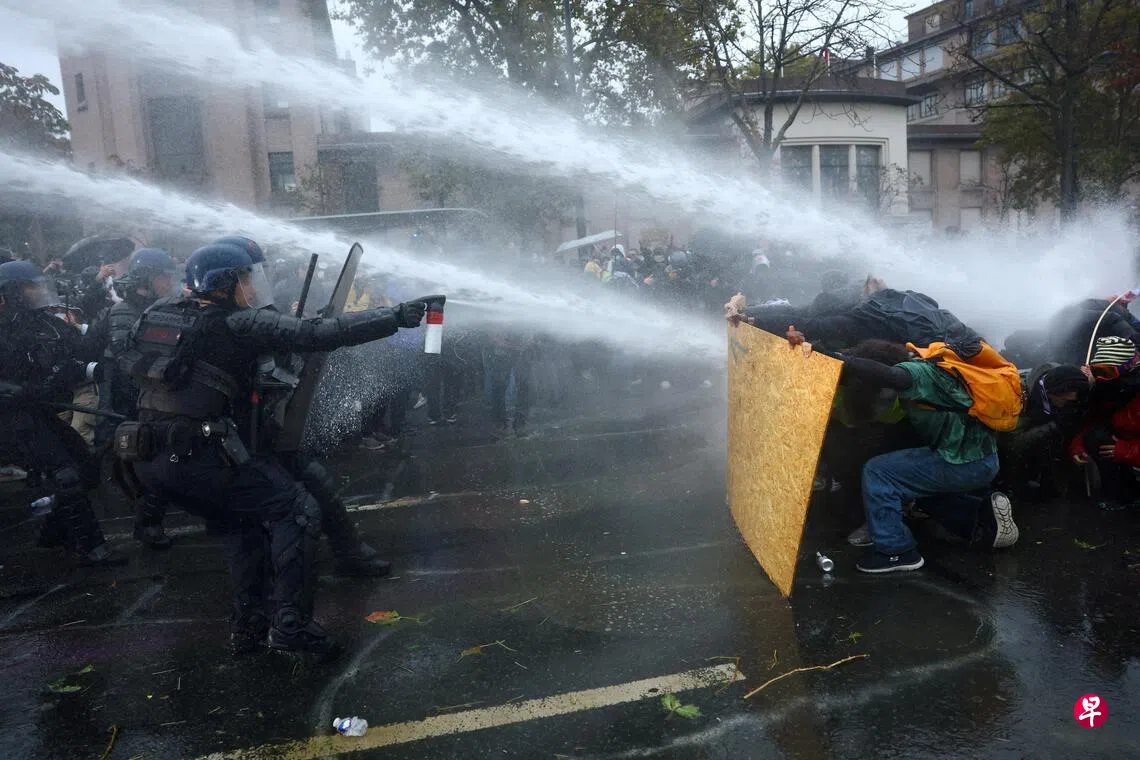
A second wave of protests against the high cost of living and inadequate public services swept across France this weekend, with hundreds of thousands of people once again taking to the streets in major cities. Heightened security and restrictions prevented a repeat of the widespread rioting seen during the first wave of protests a week earlier, but clashes between police and protesters still broke out, with more than 1,300 people arrested.
French authorities said about 410,000 people took part in demonstrations on Saturday (24 October), while unions put the turnout at as many as 800,000. The authorities deployed 70,000 police officers.
Interior Minister Laurent Nunez said Saturday’s marches were calmer than those the previous weekend, with no attacks on public buildings. He attributed this to a stronger police presence on the streets, swifter action and multiple checks ahead of the demonstrations, which better protected shopowners.
However, Nunez condemned the extremely elevated level of violence by some far-left “Black Bloc” extremists against law enforcement officers. The authorities arrested 1,314 people, while 53 officers were injured in the clashes and another two were seriously injured.
In Paris, the main demonstration was largely peaceful, but clashes broke out as crowds dispersed. Nunez said “500 casseurs (thugs)” at the rear of the march had instigated the trouble.
In Cannes and Montpellier, clashes between far-right activists and far-left radicals went beyond what had been expected. Looting broke out on the fringes of marches in Marseille and Grenoble.
According to reports by AFP, Reuters and Bloomberg, riot police fired tear gas at protesters in the capital Paris, as well as Marseille, Lyon, Bordeaux, Lille, Toulouse, Montpellier and Nantes.
Bans on some demonstrations spark public anger as protests set to continue next week
To prevent marches from descending into riots, French President Emmanuel Macron’s government had ordered police to keep protesters out of mall-dense city centres, including Place de la Bastille, a site commemorating the French Revolution, and imposed curfews in cities such as Lyon. Macron also declared demonstrations not organised by unions “illegal” and ordered them to be banned.
However, these measures were also seen as infringements of the right to demonstrate, sparking public anger. The Yellow Vest movement, which organised the protests, called on people to demonstrate again next Saturday (31 October) for “the freedom to protest”. Union leaders also called for a nationwide general strike on 5 November.
Far-left presidential candidate Jean-Luc Melenchon, who joined the march in Paris, said the movement “is going to repeat itself every week”.
Protests over high living costs flare again across Europe
Beyond France, demonstrations and riots over rising living costs also broke out in cities across Italy, Belgium, Spain, Portugal and Albania.
In Barcelona, masked rioters took advantage of the chaos to loot shops and set fires. Police arrested about 100 people, where around a quarter of them are minors. In Brussels, police used tear gas and pepper spray to disperse crowds during clashes with protesters.
Clashes between police and protesters broke out in the Italian capital Rome, as well as Milan and Bologna. In Turin, police used tear gas after demonstrators threw paving stones and bottles at officers.
Anti-government student protests in Albania also escalated into violent clashes. Protesters threw stones at police and started a fire at the door of the agriculture ministry. Riot police used tear gas, water cannons and rubber bullets to disperse the crowds.
