

North Korean leader Kim Jong Un made a surprise visit to Dandong in China’s Liaoning province over the weekend, wrapping up his trip in a single day. Analysts see it as an exercise in pragmatic diplomacy, reaffirming the traditional friendship between North Korea and China to secure economic cooperation. It may also have been intended to consolidate China’s role as a strategic backer, strengthening Pyongyang’s hand in future negotiations with the US.
However, Kim’s departure without meeting Chinese President Xi Jinping, a break with the pattern of his previous visits, suggests that a resumption of North Korea-US dialogue through Xi’s mediation is unlikely.
The Korean Central News Agency (KCNA) reported on Sunday (25 October) that Kim had travelled from Sinuiju in North Korea into China via the New Yalu River Bridge to Dandong on 24 October to attend events commemorating China’s participation in the Korean War.
Kim visited the Memorial Tower and Memorial Hall of the War to Resist US Aggression and Aid Korea in Dandong, stressing his determination to carry forward “the friendship between North Korea and China forged in blood”. In KCNA’s report, Kim referred to the two countries’ blood alliance five times, underscoring their shared historical memory.
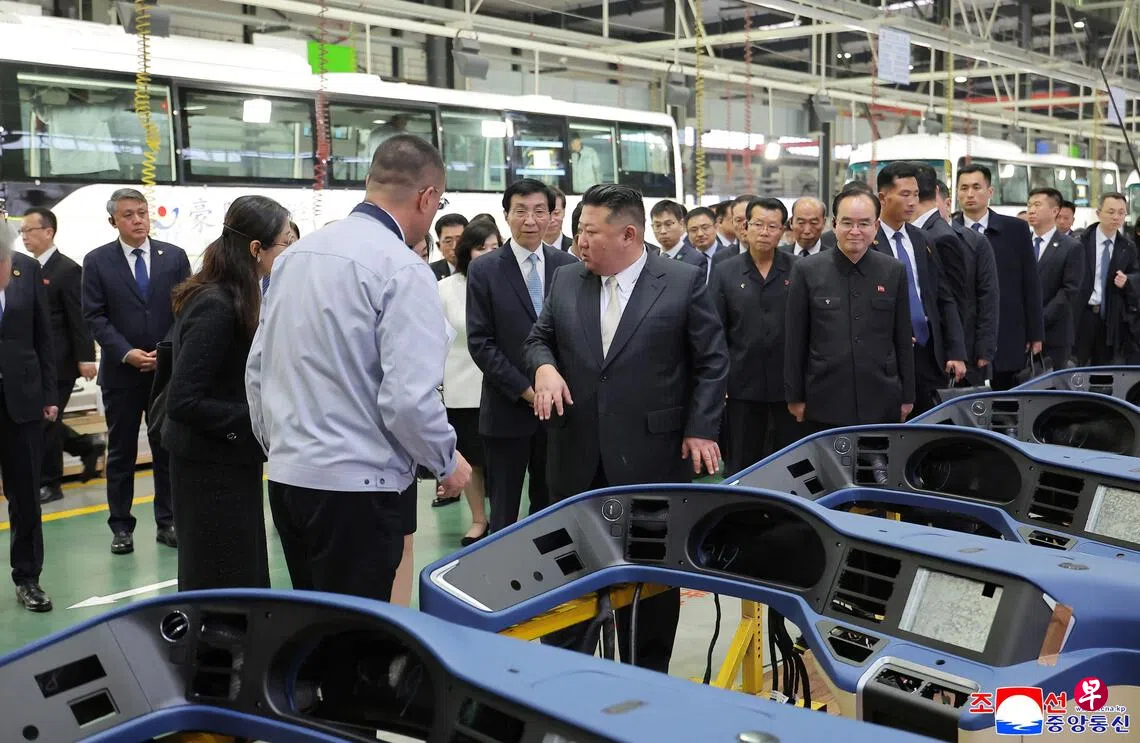
Notably, the New Yalu River Bridge was a key setting for the visit. Kim travelled between the two countries by car and, at the midpoint of the bridge, stressed its historic mission of connecting North Korea and China and promoting exchanges. He expressed hope that the two sides would expand cooperation. He also visited a car factory in Dandong, signalling a desire to strengthen economic and trade cooperation.
Lim Eul-chul, a professor at the Institute for Far Eastern Studies at South Korea’s Kyungnam University, described the trip as an example of “Kim Jong Un-style pragmatic diplomacy”, leveraging historical and ideological ties for tangible gains.
Park Won-gon, a professor at Ewha Womans University, said North Korea remained dissatisfied with the extent of China’s efforts to advance bilateral economic cooperation. Kim’s inspection of the New Yalu River Bridge could be seen as conveying to Beijing his hopes for stronger economic and trade ties.
No Xi meeting on Kim’s China visit suggests substantive coordination on North Korea-US talks has yet to begin
Another notable aspect of the visit was that, for the first time, Kim ended a trip to China without meeting Xi. On previous visits, Kim had always held talks with the Chinese president. This time, however, he was received only by Wang Huning, chairman of the Chinese People’s Political Consultative Conference and the fourth-ranking member of China’s leadership — a clear departure from past practice.
There is precedent for a Xi-Kim meeting serving as a prelude to a Trump-Kim summit.
Before his historic first meeting with US President Donald J. Trump in Singapore in 2018, Kim visited China twice to meet Xi — once in Beijing and once on Bangchuidao Island in Dalian. He also travelled to Beijing for consultations ahead of the 2019 North Korea-US summit in Hanoi. The absence of a meeting between the Chinese and North Korean leaders this time therefore appears to suggest that preparations for North Korea-US dialogue have not yet reached the stage of substantive coordination.
Nevertheless, senior diplomats, including Chinese Foreign Minister Wang Yi and North Korean Foreign Minister Choe Son Hui, took part in events during Kim’s visit. This has prompted speculation that the two sides may have exchanged views on North Korea-US dialogue or their strategies towards Washington.
Yang Moo-jin, a professor at the University of North Korean Studies, did not rule out the possibility that the two sides had discussed the North Korea-US dialogue. Kim may hope to enlist Xi’s mediation to encourage Trump to push for a resumption of talks.
Cha Du-hyeogn, vice-president of the Asan Institute for Policy Studies, said that without a meeting between Kim and Xi, it was difficult to conclude that North Korea and China were coordinating on North Korea-US dialogue. The visit could nonetheless be seen as a diplomatic signal from Pyongyang to Washington.
China may prioritise stability on Korean peninsula to avoid disruption to US ties
From China’s perspective, amid continuing strategic competition with the US, Beijing may place greater weight on maintaining stability on the Korean peninsula to avoid any unexpected disruption to China-US relations over North Korea. In particular, following a recent landmine explosion in the demilitarised zone between North and South Korea, Pyongyang has continued to issue military threats against Seoul, adding to regional instability.
South Korean public opinion analysis suggests that Beijing’s decision to maintain high-level contact with Pyongyang without arranging a meeting between their top leaders may have been intended to preserve diplomatic room for manoeuvre. While Kim’s visit highlights warming ties between North Korea and China, whether it can pave the way for the North Korea-US dialogue remains to be seen.
