

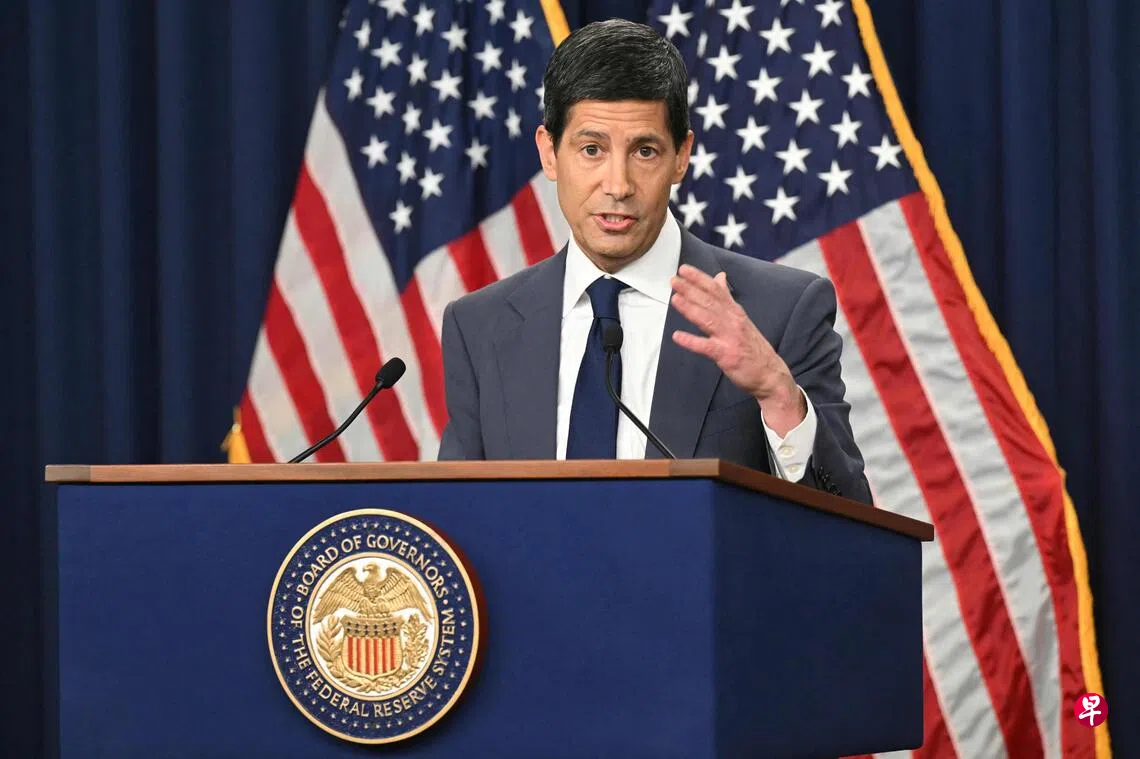
With less than a week to go before the US midterm elections, Federal Reserve Chair Kevin Warsh announced on Wednesday that policy rates would remain unchanged. He stressed that the decision not to raise rates had nothing to do with politics, indirectly rejecting President Donald Trump’s accusations that Fed policymakers were working against him at every turn.
Fed policymakers voted 10–2 on Wednesday (28 October) to keep the federal funds rate in a target range of 3.75% to 4%. The two dissenters, Vice-Chair Lisa Cook and Cleveland Fed President Beth Hammack, both favoured a 0.25 percentage point increase.
“We just came out of a heck of a family fight.” Warsh revealed at the subsequent press conference that Fed policymakers had ultimately decided to hold rates steady after that debate. He said, “I think we came to the right policy decision for this moment, and I'm honoured to be here and honoured to be the chairman of this group.”
Warsh stressed, “Politics played no role in the decision. I just spent two days with my colleagues upstairs. I didn't hear an utterance about politics. I didn't hear a reference to politics, elections, what's happening in the next week.”
He also said the Fed would receive more data in the coming weeks, putting it in a better position at its December meeting to decide whether to raise rates.
The midterm elections will be held next Tuesday (3 November), with Republicans facing a strong challenge from the Democrats as they seek to retain control of both the Senate and the House of Representatives. Polls show that voters are most concerned about the cost-of-living burden caused by persistently high inflation and borrowing costs.
Trump had repeatedly pressured the Fed to cut rates, but all its policymakers, including Warsh, unanimously backed a 0.25 percentage point increase in September — the first rate rise in three years. Although Trump did not blame Warsh at the time, he targeted the other policymakers, accusing them of ill will and partisan bias.
After the Fed announced its latest rate decision on Wednesday, Trump told reporters he had yet to speak to Warsh. In an interview with CNBC, Treasury Secretary Scott Bessent said he and Trump “have great confidence that Chair Warsh will steer the Fed between the right combination of growth and inflation”.
However, he reiterated the Trump administration’s opposition to rate increases. He said some Fed policymakers believed that allowing inflation to remain high for an extended period would suggest “a lack of will” to curb it, but he did not share that view.
CNN: Fed’s pause risks repeating inflation misjudgement
In an analysis published on Wednesday, CNN said the Fed’s decision not to raise rates again despite persistently high inflation risked repeating its mistake in 2021, when it misjudged inflation as transitory just as COVID-19 was subsiding.
The article noted that September’s inflation data had already shown an unexpected rebound in housing and rental costs, while prices for some services had risen more than expected. Massive investment in artificial intelligence (AI) data centres had overheated the economy, driving up electricity bills and prices for building materials and even goods such as smartphones and personal computers. A renewed escalation in the US-Iran conflict could also send energy prices higher. By its December meeting, the Fed could face an even more difficult situation, requiring a larger rate increase.
After misjudging inflation, the Fed only began raising rates rapidly and sharply in 2022, dealing a severe blow to financial and housing markets. Fortunately, this did not tip the economy into recession. Now, “It’s not a wager a lot of economists are eager to place again.”
