

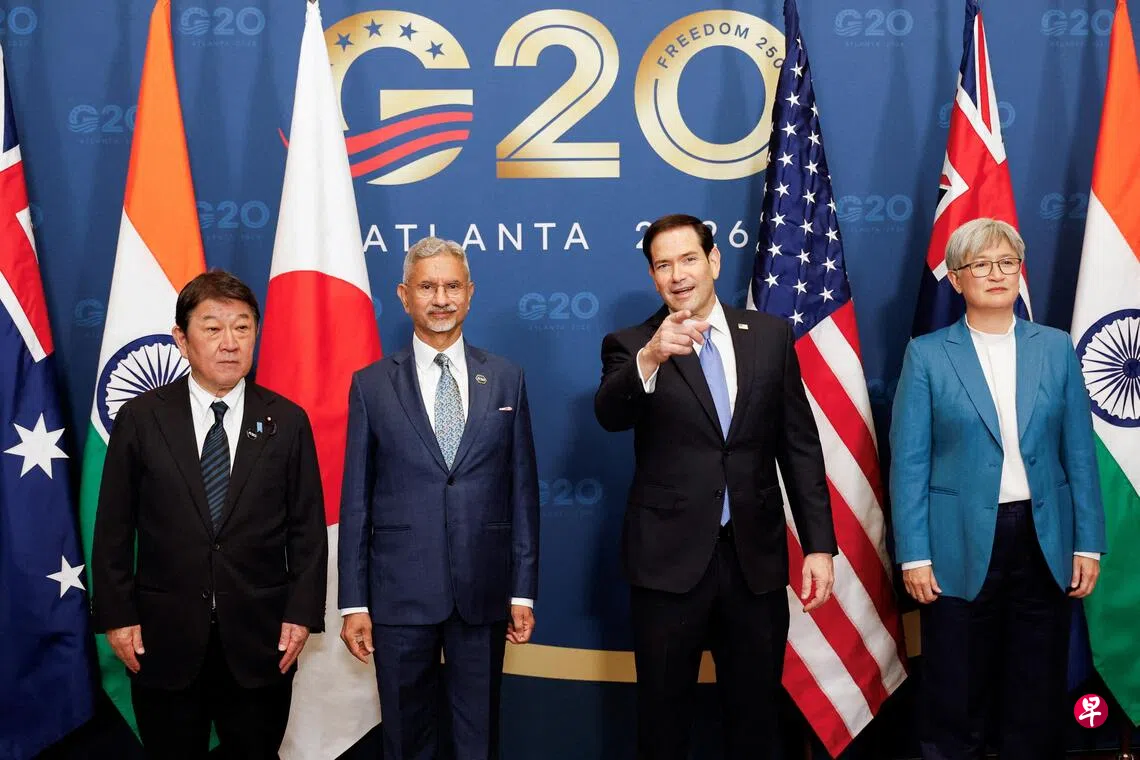
The foreign ministers of the US, Japan, India and Australia have pledged to work together to build open and reliable global supply chains, expressing serious concern over “economic coercion”, including the arbitrary imposition of export restrictions. Although their joint statement did not name China, it was clearly aimed at Beijing’s export controls on critical minerals and its industrial policies.
The foreign ministers of the four countries in the Quadrilateral Security Dialogue (Quad) held their third meeting this year in Atlanta, US, on Saturday (31 October). They met on the sidelines of a foreign ministers’ meeting of the Group of 20 (G20), which also includes China.
In their statement, the four foreign ministers reaffirmed their support for a free and open Indo-Pacific, stressing that open and reliable global supply chains help safeguard economic security and promote global stability and prosperity.
The statement also expressed serious concern over economic coercion, including the arbitrary imposition of export restrictions and non-market policies and practices that create overcapacity, disrupting global supply chains in critical industries.
Japan has recently sharply criticised China’s restrictions on exports of critical minerals. The US, meanwhile, has sought to rally G20 countries that are similarly wary of China’s dominance of supplies of rare earths and other critical minerals.
The impact of export restrictions and overcapacity has been a major source of criticism of China, but Beijing has consistently denied that it has an overcapacity problem.
US Secretary of State Marco Rubio said at a press conference that the Quad was not "an anti-China or anti-anybody coalition," adding that the joint statement was raising concerns about economic coercion through behaviors and activities that he said were "coming repetitively from one country."
Alongside voicing their concerns, the four countries advanced practical cooperation, pledging more than US$85 million (about S$109 million) in assistance to support the development of trustworthy artificial intelligence (AI) technologies in the Indo-Pacific.
The four countries will also introduce new measures to identify vulnerabilities in semiconductor and related supply chains early, reducing the risk of supply disruptions.
First leaders’ summit since 2024 planned for next month, with Trump expected to attend
Beyond economic security, the four foreign ministers also stressed the vital importance of key maritime routes to trade and energy supplies.
They called for the safety of seafarers and vessels to be safeguarded, for ships to be allowed unimpeded passage without tolls, and for navigational rights and freedoms in the Strait of Hormuz, the Red Sea and the Bab el-Mandeb Strait to be upheld.
The four countries are also preparing for a leaders’ summit, planned for November on the sidelines of the ASEAN summit in Manila, the Philippines. US President Donald J. Trump is expected to attend. It would be the Quad’s first leaders’ summit since 2024.
Rubio said he hoped an announcement about the summit could be made soon, but gave no further details. He also said the four countries planned to establish a business forum to create more opportunities for companies to cooperate. In addition, they had made significant progress in pooling resources to respond jointly to humanitarian crises and natural disasters.
